Top 5 Content Marketing Strategies to Drive Leads in 2025

Top 5 Content Marketing Strategies to Drive Leads in 2025

Content Marketing Strategies to Drive Leads

Content marketing is constantly evolving, and finding the right content marketing strategies to drive leads has never been more critical. Each year brings new challenges and opportunities for businesses to attract and engage their target audiences. If you’re not staying up to date with the latest trends, you risk falling behind.

In 2025, the landscape will shift yet again, with new technologies and consumer behaviors reshaping how brands connect with their audiences. However, one thing will remain the same: the need for innovative strategies that capture attention and drive actual, measurable leads.

Before diving into the strategies, it’s important to address some fundamental questions about content marketing and how it contributes to lead generation. These answers will help you better understand how to apply the strategies to your marketing efforts.


How Does Content Marketing Generate Leads?

Content marketing generates leads by providing valuable information that addresses the pain points of your target audience. Instead of pushing your product, content marketing pulls your audience in by offering solutions, insights, and answers that resonate with their interests. By creating content that aligns with what your customers are searching for, you can build trust, establish authority, and ultimately guide them toward conversion.

How to Increase Leads from Content Marketing?

To increase leads from content marketing, focus on delivering relevant content tailored to your audience’s preferences. Optimize your content for SEO, promote it across multiple channels like social media and email marketing, and make sure it includes strong CTAs. Regularly analyze your metrics to understand what’s working, and adjust your strategy accordingly. Engaging content that encourages interaction—such as quizzes, surveys, or product demos—also helps increase lead conversions.

Lead generation

Which Type of Content is Most Effective for Lead Generation?

Interactive content, educational blog posts, gated content, case studies, and video tutorials are highly effective for lead generation. These types of content engage users more deeply, offer value, and often include actionable steps that can drive a lead to convert. For instance, case studies can show the real-world impact of your product or service, while video tutorials can visually demonstrate how your solution works.


How Can Content Marketing Drive More Traffic?

Content marketing drives traffic by providing value through various forms of content, such as blogs, videos, social media posts, and more. Well-optimized content that answers specific user queries and matches the search intent will rank higher in search engine results and drive organic traffic. By understanding your buyer personas, you can create content that resonates with your target audience’s needs and preferences. Additionally, by promoting your content on the right platforms and encouraging social sharing, you increase its visibility and reach, which leads to more traffic.

So, what should your business focus on in 2025?

Here are the top 5 content marketing strategies to drive leads and help you stay ahead of the competition in 2025.


Top 5 Content Marketing Strategies to Drive Leads

content marketing strategies to drive leads in 2025

1. Interactive and Personalized Content

In today’s digital age, personalization is no longer a luxury—it’s an expectation. In 2025, this trend will only grow, and the brands that master personalization will dominate the market. Interactive content plays a key role in delivering these personalized experiences.

What does this look like? Think about quizzes, calculators, polls, or even augmented reality experiences that engage users in a way static content can’t. Instead of passively consuming information, users interact with your brand, and in doing so, they leave behind valuable data that can be used to personalize future interactions.

For example, imagine a real estate agency that offers an interactive home affordability calculator on its website. Users input their income, savings, and desired location to get a list of homes within their budget. This tool engages the visitor and gives the agency key insights into what the user wants—perfect for follow-up targeted marketing.

The Impact of Interactive Content on Lead Generation

Interactive content is effective as lead magnets because it increases engagement by providing value in exchange for the user’s time. When combined with personalization, it creates a memorable experience that builds trust. Most importantly, it lets you capture more qualified leads because users are already invested in interaction.

Video and Short-Form Content

2. Video and Short-Form Content Domination

If you’re not already using video in your content marketing strategy, 2025 is the year to start. And it’s not just any video—short-form content is where it’s at. Platforms like TikTok, Instagram Reels, and YouTube Shorts have proven the power of snackable, fast-paced content that grabs attention quickly.

61% of B2B marketers see their organizations increasing investments in video in 2025, highlighting the growing importance of this medium. In a world of information overload, audiences crave quick, easy to digest, and entertaining content. Tutorials, product demonstrations, or behind-the-scenes glimpses into your brand’s daily operations are perfect ways to showcase what you offer in an authentic and relatable way.

Why Short-Form Videos Matter

Short-form content aligns with how users consume media today—fast and on the go. With the average attention span shrinking, brands must deliver their message quickly and effectively. These bite-sized videos are perfect for grabbing attention and encouraging viewers to take the next step, whether visiting your website, signing up for a newsletter, or making a purchase.

The Power of Video for Lead Generation

Creating engaging, shareable video content increases brand awareness and visibility. A 30-second video can be all it takes to convert a viewer into a lead—especially when paired with a compelling call-to-action (CTA) like “Sign up for exclusive updates” or “Learn more about our services.”

3. AI-Generated and Augmented Content

Artificial intelligence (AI) is no longer a futuristic concept—it’s here, and it’s changing the way content is created and delivered. In 2025, AI-powered content creation tools will take center stage, enabling brands to produce personalized, high-quality content faster than ever before.

With AI handling content creation, you can quickly develop optimized landing pages tailored to different audience segments, allowing for higher personalization and relevance in your marketing. Notably, under 50% of marketers identify content creation as the leading application of AI in their content marketing strategies to drive leads. AI can generate everything from a blog post to social media content, video scripts, and product descriptions.

But it doesn’t stop there—AI also powers the data analytics that help brands understand customer behavior, predict trends, and personalize the customer journey. For example, AI can analyze customer data and automatically generate personalized content recommendations based on each visitor’s behavior. You can use AI to create dynamic email campaigns that adapt in real time, responding to user interactions to deliver relevant content.

Why AI Matters for Lead Generation

AI-driven content creation allows you to scale personalization efforts, delivering the right message to the right person at the right time. By making your content highly relevant to individual users, you increase the likelihood of conversion—whether that’s capturing a lead or making a sale.

And with AI handling many of the repetitive tasks associated with content creation, your marketing team can focus on strategy and creativity, driving even more meaningful engagement.

Voice assistant

4. Voice Search Optimization

With smart assistants like Alexa, Google Assistant, and Siri becoming household staples, voice search continues to rise. Did you know that 93.7% of search queries are answered accurately by voice search assistants, showcasing their reliability? Projections indicate that by 2025, over half of all online searches will be conducted via voice. So, if you’re not optimizing your content for voice search, you’re missing out on a huge opportunity to drive leads.

Voice search queries tend to be longer and more conversational than typed searches. For instance, instead of just searching ‘home builders,’ a user might ask, ‘How do I choose the best home builder for my project?’ or ‘What are the steps to building a new house?’ This shift in search behavior highlights the importance of optimizing content to answer these specific, more detailed questions.

How to optimize for voice search:

  • Focus on long-tail keywords that mimic natural speech patterns.
  • Create content that answers specific, question-based queries.
  • Structure your website so that key information is easily found and quickly pulled into a voice search result.

Why Voice Search Works to Generate Leads

When your content is optimized for voice search, you’re making it easier for users to find you, positioning your brand as the answer to their questions. This builds trust and increases the likelihood that they’ll engage further, whether by visiting your landing page or contacting your business for more information.

User-generated content

5. Community-Driven and User-Generated Content

In an age where consumers are bombarded with brand messages, people seek authenticity. That’s where community-driven and user-generated content (UGC) comes into play. In 2025, fostering an engaged community around your brand will be crucial to driving leads.

UGC refers to content your customers or audience creates, like reviews, testimonials, and social media posts. Real people sharing their experiences with your brand builds trust and authenticity—far more than any marketing message you could create.

How to leverage UGC and the community:

  • Create branded social media groups where users can share their stories and engage with one another.
  • Encourage customers to post reviews or tag your brand in their social media content.
  • Develop ambassador programs that reward loyal customers for promoting your brand.

Why UGC Works for Lead Generation

UGC serves as social proof—for each piece of content your audience shares, potential customers are more likely to trust a recommendation from a fellow consumer than a brand. You can build credibility and convert prospects into quality leads by showcasing real-world examples of how people use and love your products.


The Road Ahead

The content marketing landscape in 2025 will be more dynamic and interactive than ever before. From AI-powered personalization to short-form videos and community-driven content, these content marketing strategies to drive leads are designed to help businesses stand out and generate meaningful engagement.

As a brand, the key is to stay adaptable and embrace the tools and technologies to keep you ahead of the competition. Whether optimizing for voice search or engaging users with interactive content, now is the time to implement these strategies.

Ready to boost your content marketing strategy for 2025? Take time out and contact us today to discover how we can help you drive more leads with these cutting-edge techniques.

Are You Ready to Take Time Out?

Let’s create strategies that deliver real results for your business.
SEO Web Design: Improve User Experience and Search Rankings

SEO Web Design: Improve User Experience and Search Rankings

SEO Web Design

In today’s digital marketing landscape, having the presence of just a website isn’t enough. Your site needs to be optimized for users and search engines. That’s where SEO web design comes in. But what is SEO web design, and why is it important for your business? In this blog, we’ll look at the intersection of web design and search engine optimization (SEO) and how combining the two can boost your website’s performance.


What is SEO in Web Design?

SEO is about making your website rank higher on search engine results pages (SERPs). It encompasses keywords and technical and design elements that improve user experience (UX) and search rankings.

But, when we talk about SEO in web design, we’re talking about strategies and techniques that make your website look good and structured so that search engines can easily crawl and index it. This includes:

  • Site Structure: Logically structuring your site so users and search engines can navigate it.
  • Responsive Design: Making your website mobile-friendly, as search engines favor mobile-optimized sites.
  • Page Speed: Ensuring your site loads quickly to improve user experience, which is also a ranking factor.

By integrating SEO into your website design, you create a foundation that attracts visitors and keeps them engaged.

SEO and Web Design

Understanding SEO Web Design

SEO web design is the marriage of beauty and functionality. While it’s easy to get caught up in how a website looks, a good web design should prioritize UX and SEO. Here are some key things to consider:

User Experience

A good UX design is about how a user interacts with your site. This includes:

  • Navigation: Make it easy for visitors to find what they need. If users can’t navigate your site quickly, they’ll leave, and your bounce rate will increase.
  • Clear Calls to Action (CTAs): A good CTA guides users to take the desired action, whether buying, signing up for a newsletter, or contacting your business.
  • Visual Hierarchy: Use design elements like font size and color contrast to draw attention to important information and guide the users’ focus.

Search Engine Optimization

On the SEO side, consider the following:

  • Keywords: Research and include relevant keywords naturally into your content, headings, and meta descriptions.
  • Meta Tags: Write great meta titles and descriptions that entice users to click through to your site.
  • Alt Text: Add descriptive alt text to images to improve accessibility and help search engines understand the content.

By combining UX and SEO, you create a website that looks good and performs well in search engines.

SEO Web Design 2

How Does Web Design Improve SEO?

A well-thought-out web design can do wonders for your site’s SEO. Here’s how:

1. Improved Crawlability

Search engines use bots to scan your site. A well-structured website allows these bots to crawl and understand your content easily. Using logical URLs and XML sitemaps makes it easier for search engines to index your pages, which can help your site appear in more search results.

2. Faster Loading Times

Did you know that nearly half of users expect a webpage to load in two seconds or less? 53% of mobile site visitors will leave a page that takes longer than three seconds to load. Slow websites frustrate users and negatively impact your SEO. By optimizing images, reducing heavy scripts, and cutting down server response time, you improve user satisfaction and search rankings.

3. Mobile Optimization

Responsive design is essential, as mobile traffic makes up more than half of all web usage, with 58% of global website traffic accounting for mobile devices. Search engines like Google prioritize mobile-optimized sites, meaning you’re likely missing out on traffic if your SEO-friendly website isn’t responsive. A mobile-first approach ensures you cater to these users and boosts your site’s visibility in search results.

4. Enhanced User Engagement

A well-designed website keeps users on your site longer. If visitors find your content engaging and can easily navigate the site, they will likely explore more. This reduces bounce rates and signals to search engines that your site is valuable, improving your rankings. The average bounce rate varies widely across industries, typically from 26% to 70%.

A higher bounce rate often indicates user dissatisfaction, irrelevant content, or poor navigation, negatively impacting user interaction and conversions. However, internal links can encourage visitors to explore related content, boosting engagement and SEO.

User Experience

The Impact of SEO Web Design on Conversions

Integrating SEO into your website design doesn’t just improve your visibility in search results—it also directly increases conversions. Here’s how:

1. Building Trust

A well-designed, professional website promotes trust in your visitors. Users may doubt your credibility if your site looks outdated or is difficult to navigate. On the other hand, a modern, friendly web design reassures visitors that your business is reliable, building trust and encouraging conversions.

2. Streamlined User Journey

When users can easily find what they’re looking for, they are more likely to convert, whether making a purchase or filling out a contact form. By guiding users smoothly through the journey, from awareness to decision-making, your overall conversion rate will be boosted.

3. Increased Engagement

Engaging visuals, well-placed CTAs, and easy-to-navigate on-page SEO features keep users on your site longer. The more time they spend exploring your content, the higher the chances they convert into paying customers.

4. Higher ROI

Investing in SEO web design delivers a better return on investment (ROI). You establish a sustainable business model that keeps paying off by attracting the right traffic and converting visitors into customers.

Best Practices for SEO Web Design

Maximize the benefits of SEO web design with these best practices:

1. Use Headings and Subheadings

Properly structured headings, such as H1, H2, and H3 tags, make your content more accessible for both users and search engines to navigate. This improves readability and enhances your SEO strategy by helping search engines understand the context of your pages.

2. Optimize Images and Alt Text

Compressing images reduces loading times, improving user interaction and search engine rankings. Descriptive alt text for images makes your site more accessible and contributes to technical SEO, helping search engines index your content more effectively.

3. Create a User-Friendly Navigation Structure

A straightforward, intuitive navigation menu lets users quickly find the necessary information. This improves the user journey, reduces bounce rates, and supports better rankings by making your site more engaging.

4. Utilize Schema Markup

Implementing schema markup helps search engines better understand your content, potentially boosting your visibility in search results through rich snippets. It also enhances user engagement by providing clearer, more structured information in SERPs.

5. Use Internal Linking Strategies

Internal links guide users to more relevant content and help search engines understand the relationship between pages on your site. A solid internal linking structure distributes link equity across your pages, ensuring that important content gets properly indexed and ranked. When setting up internal links, use descriptive anchor text that includes relevant keywords to give both users and search engines more context about what the linked page contains.

6. Monitor and Analyze Performance

Use tools like Google Search Console to track your website’s performance. Regular analysis of traffic sources, user behavior, and conversion rates helps identify areas for improvement and refines your SEO efforts.

7. Incorporate Technical SEO

Technical SEO involves optimizing your website’s backend elements like page speed, mobile responsiveness, and HTTPS security. These factors directly affect your site’s ranking potential and provide a seamless customer journey.

8. Focus on On-Page SEO

Optimizing each web page for SEO-friendly performance includes refining title tags, meta descriptions, and header tags and incorporating targeted keywords within your content. This attention to detail will help individual pages rank better and attract more relevant traffic.

Common mistakes to avoid

Common Mistakes to Avoid

When working on your SEO web design, be mindful of these common pitfalls:

1. Overloading with Keywords

Keyword stuffing can lead to penalties from search engines. Instead, focus on creating high-quality, engaging content that naturally incorporates relevant primary keywords and related terms. This approach makes your content more readable and SEO-friendly without resorting to unnatural repetition.

2. Neglecting Mobile Users

Always prioritize mobile optimization. If your site isn’t mobile-friendly, you risk losing significant traffic. Mobile responsiveness is vital to improving both the customer journey and SEO rankings.

3. Ignoring Page Load Speed

Page load speed directly impacts user satisfaction. If your website loads quickly, visitors will stay. Regularly test your site’s speed and use techniques like image compression and code optimization to keep your load times competitive.

4. Overlooking the Role of Social Media

While social media doesn’t directly impact your SEO rankings, it plays a crucial role in amplifying your content and driving traffic to your site. Sharing your blog posts, product pages, or case studies across platforms like Facebook, Instagram, LinkedIn, and X can increase visibility.

The more engagement your content gets through likes, shares, and comments, the more it signals to search engines that your site is active and authoritative. Additionally, social media can help build backlinks as more users discover and link your content, improving your site’s authority and SEO performance.

SEO navigation structure

Examples of Effective SEO Web Design

To showcase the principles we’ve discussed, here are a few examples of websites that excel in SEO web design:

  • Airbnb: Known for its intuitive navigation and mobile optimization, Airbnb’s clean design, coupled with high-quality visuals, creates an engaging customer experience that drives conversions.
  • Amazon: Amazon’s robust and mobile-friendly platform emphasizes speed and usability. Its SEO-optimized product pages, fast load times, and personalized recommendations enhance the UX, driving traffic and conversions.
  • Shopify: Shopify uses a fast, SEO-friendly design that’s optimized for mobile. Its quick loading times and clean layout make shopping effortless for users, increasing conversion rates.


Achieve Online Success with SEO-Optimized Web Design

Integrating SEO into your web design is essential for any business aiming to succeed online. Focusing on user experience and SEO best practices will enhance your site’s visibility, attract the right traffic, and ultimately increase conversions. Effective content marketing strategies, like sharing quality content across social platforms, can significantly boost your site’s relevance and authority, leading to better search results and increased engagement.

As part of your digital marketing strategy, consider how web design and SEO work together to create an effective SEO-friendly website and evaluate if your site truly supports your business goals. If you’re ready to take your web design to the next level, Time Out Marketing is here to help. Whether you want to revamp your site, create a new one, or improve your SEO, contact us today to get started!

Are You Ready to Take Time Out?

Let’s create strategies that deliver real results for your business.

The Impact of AI Overview on Search Results

The Impact of AI Overview on Search Results

AI Overview

Artificial intelligence (AI) is transforming industries, and search engines are at the forefront of this evolution. As the internet expands, AI has become essential in refining how search engines operate, enhancing accuracy, relevance, and user experience. One significant outcome is the emergence of the AI overview, which reshapes how search results are generated and displayed.

In this blog, we’ll break down what an AI overview means in the context of search, how it functions, and the ways it’s transforming how we discover information online. Whether you’re a digital marketer or a search engine optimization (SEO) strategist, understanding AI’s growing influence on search results is essential.


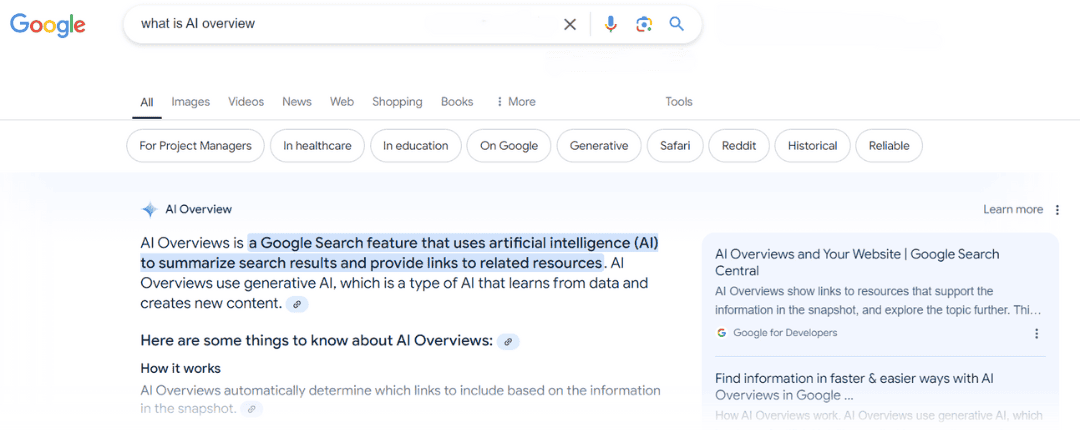
What is the AI Overview in Search?

The term “AI overview” refers to how search engines utilize artificial intelligence to deliver more efficient, intuitive, and user-focused results. By analyzing data in real-time, AI interprets user intent and predicts what users are likely looking for based on search patterns and behavior. Generative AI, powered by advanced machine learning, enhances this by generating responses, snippets, and relevant information tailored to user queries, even for complex or less common searches.

Rather than relying solely on keywords, AI processes contextual information—such as how queries are phrased, device types, location, and even the time of day—to provide personalized, relevant results. Essentially, AI learns to refine the search process to make it more accurate and effective for each user, often solving the problem of irrelevant search results by understanding the context better.

What is AI Overview in Search

Global Availability of AI Overview in Search

The AI overview feature in Google is widely available in many countries. Still, its availability can vary depending on local regulations, the maturity of AI technologies in specific regions, and user adoption.

Google’s AI-powered features, such as featured snippets, Knowledge Graphs, and AI-driven recommendations, are generally available globally, including in countries like the United States, the United Kingdom, Canada, Australia, and across Europe and parts of Asia.

However, newly advanced AI features, like Generative AI-based search summaries and conversational AI search (e.g., Google Gemini, formerly Bard), often roll out in specific regions, like the US, before expanding to other countries. This gradual release is standard for cutting-edge AI technologies as they are tested and optimized for wider global usage.

The availability of AI overview in certain countries may also be influenced by:

  • Local laws regarding data privacy (e.g., GDPR in Europe)
  • Censorship or internet regulations, as in countries like China
  • Adoption of Google’s newer AI systems, which could take time to launch globally


How AI Has Evolved in Search Engines

To understand the full impact of AI in search engines, it’s important to look back at how search engines have evolved. In the early days, search engines used simple keyword matching to deliver results. If you typed in “best pizza restaurants,” the search engine would match websites that contained those exact words.

Now, with AI-driven algorithms like Google’s RankBrain and BERT (Bidirectional Encoder Representations from Transformers), search engines can understand the meaning behind the words. RankBrain, for example, uses machine learning to process unfamiliar queries, while BERT enables Google to better understand context, especially in longer or more conversational searches. These systems allow search engines to move beyond keyword matching, delivering results based on the whole meaning of the query.

How does AI Overview work

How Does AI Overview Work?

At its core, an AI overview analyzes huge amounts of data and learns from user interactions to better anticipate what users want. AI algorithms collect and process information from previous searches, user behavior, and other signals to deliver more relevant search results. AI-powered generative models can also support this by generating relevant content snippets based on a user’s query.

For example, if you search for “best vacation spots,” AI overview doesn’t just look for pages with the term “vacation spots.” Instead, it evaluates your search history, location, preferences, and even the time of year to offer more targeted suggestions. It might prioritize tropical destinations in winter or suggest trending locations based on current events.

AI also works to display search results in the most helpful way possible. Google, for instance, uses AI to power its Knowledge Graph, which provides quick facts and answers directly in the search results. This is part of the AI overview process, where search engines aim to present summarized, easily digestible information right at the top, reducing the need to click through multiple websites.


Impact on Clicks: The Rise of Zero-Click Searches

One of the consequences of AI Overview providing immediate answers is the rise of “zero-click searches,” where users get the information they need directly from the SERPs (search engine results pages) without having to click on a website. While this enhances user experience by delivering quick answers, it can significantly reduce website traffic, as fewer users feel the need to visit individual pages.

For SEO professionals, this shift means evolving strategies to ensure content is optimized for featured snippets and other elements on the SERPs. High-ranking content must still compete for visibility in these AI-driven results, maintaining its relevance despite fewer clicks. Creating quality content that directly aligns with user intent and meets the needs of the SERP layout is crucial for ongoing success.

Getting an AI Overview on Google

If you’ve used Google recently, you’ve likely encountered AI-driven features without realizing it.

Here’s how to get an AI overview on Google:

1. Perform a search – Type or speak your query into Google, whether it’s a short, specific search or a longer, conversational one.

2. Explore featured snippets – The box of information that appears at the top of the search results is powered by AI. This snippet quickly answers your question, often pulling data from a high-ranking website.

3. Utilize voice and visual search – Google’s AI allows users to perform voice searches using Google Assistant or search via images using Google Lens. This is an increasingly popular way to get an AI-driven overview without typing anything.

The AI overview filters and presents the most relevant information, streamlining your search experience. For users, this means less time scrolling through irrelevant links and more immediate access to what they need.

AI Overview example

Personalized Search Results

One of the most significant ways AI impacts search results is through personalization. AI tailors results based on each user’s preferences, browsing history, location, and even their device. This means that two people searching for the same thing may get different results.

For instance, searching “restaurants near me” will deliver different results depending on your location. AI uses your location to present nearby options. But it goes deeper than just location-based searches. Over time, AI learns more about your preferences based on what you click on, which types of articles you read, and what you tend to avoid.

This personalization enhances the overall user experience, delivering relevant information faster. However, it also raises concerns about privacy, as some users may not want search engines tracking their every move to tailor results.


Voice Search and Conversational AI

Voice search is another area where AI has had a profound impact. With the rise of voice assistants like Google Assistant, Siri, and Alexa, more people are asking their devices for information rather than typing queries into a search bar.

AI’s ability to understand natural language through conversational AI is crucial here. Instead of searching for “weather New York,” a user might say, “What’s the weather like in New York today?” The AI processes the query, understands the context, and delivers an accurate result.

Voice search often works hand-in-hand with the AI overview, providing direct answers to questions without users needing to scroll through multiple results. This makes voice search particularly valuable for users on the go, further demonstrating the power of AI in streamlining searches.


Visual Search: The Next Frontier

In addition to voice search, AI is also driving visual search capabilities. Tools like Google Lens allow users to search using images instead of text. For example, if you take a photo of a plant or a piece of furniture, AI can identify the object and present relevant information, such as where to buy the item or how to care for the plant.

AI plays a critical role in refining visual search results by recognizing objects and understanding their context. This area has significant growth potential, especially in industries like retail and e-commerce, where visual search can drive sales and improve customer experiences.

Google lens example

SEO Strategies in an AI-Driven Search Landscape

As AI-driven search engines continue influencing the digital landscape, SEO strategies must evolve to stay effective. Rather than relying on keywords alone, AI-driven content creation is pivotal in ensuring that content resonates with users and meets their needs. Additionally, the evolution of AI-driven search results prioritizes content aligned with user intent over keyword-stuffed pages.

To succeed in this environment, SEO professionals should focus on the following key strategies:

  • Intent-Based Content: Create content that addresses the underlying intent behind queries, not just the keywords themselves. For example, answering questions directly in your content can improve your chances of appearing in featured snippets or other AI-driven results.
  • Structured Data: Use schema markup to help search engines better understand the content on your site, increasing the chances of being featured in AI-generated snippets. This structured approach aids in delivering clear and concise information to users.
  • Voice and Visual Search Optimization: As AI enhances voice and visual search, ensure your content is optimized for natural language queries and image-based searches. This means focusing on conversational keywords and visual elements that match user intent.
  • User Experience and Engagement: Prioritize creating high-quality, relevant content that serves user needs. By leveraging AI tools to track user behavior and trends, marketers can gain new insights into what content will perform best and when to deliver it.

By aligning with these strategies, SEO professionals can ensure their content performs well in the AI-driven search landscape and meets the evolving demands of users.

What's next for AI

What’s Next for AI and Search Results?

Looking forward, the future of AI in search results is promising. We can expect further advancements in personalization, making search experiences even more tailored to individual users. Voice and visual search will likely continue to grow, integrating more seamlessly with AI technologies.

In addition, AI-driven content creation will become increasingly sophisticated, enabling search engines to provide even more relevant, context-aware content that meets user needs. This will streamline the user experience and allow marketers to produce content optimized for search engines.

However, as AI becomes more sophisticated, ethical considerations must also be addressed. Issues like algorithmic bias, data privacy, and transparency in AI processes are vital to ensure that AI-enhanced search results are fair, unbiased, and respectful of user privacy.


Adapting to AI-Driven Search

The impact of AI on search results is undeniable. From personalized experiences and voice search to visual search and AI-powered SEO, AI is reshaping the way we find information online. As search engines continue to evolve, staying informed about these changes is crucial for marketers and professionals looking to stay ahead in the digital space.

The AI overview has made search results more efficient, intuitive, and tailored to individual needs. As AI technology continues to advance, the way we search, find, and interact with information will only become more innovative and refined.

To climb search engine rankings, it’s important to remember that as AI scans high-ranking pages, content quality remains paramount. Your SEO strategy must adapt to meet these evolving demands, focusing on creating valuable, relevant content for your audience.

Ready to elevate your digital presence? Contact us today, and let us help you create a customized SEO strategy tailored to the AI-driven search landscape.

Are You Ready to Take Time Out?

Let’s create strategies that deliver real results for your business.

Why Keyword Synonyms Matter for SEO and Content Marketing

Why Keyword Synonyms Matter for SEO and Content Marketing

Keyword Synonyms

In digital marketing, keywords are the building blocks of any successful SEO strategy. But if you focus on just one keyword, you could miss out on valuable organic traffic opportunities. That’s where keyword synonyms come in. By incorporating keyword variations into your content, you can expand its relevance and improve its SEO performance, helping you connect more effectively with users and search engines.

In this blog, we’ll explore the importance of keyword synonyms in SEO and content marketing, providing actionable steps to integrate them into your marketing strategy.


What is a Keyword in Simple Terms?

A keyword is a word or phrase that captures the essence of your content and reflects what users are likely searching for online. In simple terms, it’s the search term people type into search engines to find information. For example, someone searching for marketing tips might enter “online marketing strategies” or “SEO tips for beginners.”

Choosing the right keyword helps search engines understand your content and match it with relevant search queries. This makes keywords the foundation of SEO, guiding users to your information.


What is Another Word for Keyword?

A keyword is also known as a search term or focus term. These terms categorize your content and make it easier for search engines to display your page when users search for related topics. In content marketing, these terms signal to your audience that your material addresses their needs or interests.

Keyword Synonyms 2

What Are Keywords and Synonyms?

Keyword synonyms are alternative words or phrases that mean the same or nearly the same as your primary keyword. While they might not be the exact term your audience is searching for, they are closely related and can help you capture a broader audience.

For example, if your primary keyword is “SEO strategy,” a synonym could be “search engine optimization plan.” Both phrases target the same search intent but use different wording, increasing your chances of ranking for a wider range of search terms.

Incorporating keyword synonyms into your content helps search engines understand the breadth of the topic, improving your chances of ranking for related searches.


Why Keyword Synonyms Are Crucial for SEO

Search engines like Google have evolved to focus on the user’s intent rather than just the specific words typed. This is called semantic search, where the emphasis is on understanding meaning and context, not just exact keywords. Here’s why incorporating keyword synonyms can boost your SEO: 

  1. Broader Search Coverage: Including related terms increases the search queries your content can match. For example, using “content marketing strategies” and “content marketing tactics” in your content helps capture more search traffic.


  2. Better User Engagement: Users are more likely to engage if your content reads naturally and provides value. Overusing the same keyword (aka keyword stuffing) can sound repetitive, but using synonyms keeps your material flowing smoothly and more organically.


  3. Contextual Relevance: Search engines assess the relevance of information based on the context and surrounding terms, not just exact matches. Including keyword synonyms signals to Google that your content is comprehensive, improving your chances of ranking.

How to Find Keyword Synonyms

Here are four practical ways to discover keyword synonyms:

1. Google Trends and Related Searches: Use Google Trends to explore “Related Queries” for your primary keyword, or check Google’s search results for the ‘People also search for’ or “Related Searches” section at the bottom of the page. These resources provide alternative phrases and related terms.

2. Keyword Research Tools: Google Keyword Planner, SEMrush, and Ahrefs are fantastic for discovering keyword synonyms. Input a keyword, and these tools will generate variations, search volume, and competitiveness for each term.

3. Use A Thesaurus: Online thesauruses like Thesaurus.com may seem basic, but they can quickly find similar terms for your target keyword. Just ensure that the synonyms are relevant to your audience and topic.

4. Analyze Competitors’ Content: Reviewing how your competitors use keywords in their content can reveal additional terms you may not have considered. Pay attention to the headings, subheadings, and keywords they use to reach their audience.


How to Use Keyword Synonyms Effectively in Content

Once you’ve identified keyword synonyms, it’s essential to use them strategically to maximize their impact. Here’s how:

1. Avoid Keyword Stuffing: While synonyms can diversify your keyword use, don’t overdo it. Cramming too many keywords into your content reduces readability and can lead to penalties from search engines. Aim to include a keyword synonym every 150-200 words to maintain a natural flow.

2. Integrate Synonyms in Headings and Subheadings: Using keyword synonyms in headings and subheadings breaks up your content, helps search engines understand its structure, and emphasizes relevance to various search queries.

3. Use Synonyms in Meta Descriptions and Image Alt Text: Optimizing your meta descriptions and image alt text with keyword synonyms can boost SEO. This ensures every part of your content contributes to search engine visibility.

4. Maintain Content Quality: While keyword synonyms are important, content quality should always be the priority. Use them to enhance the natural flow of the text, but never at the expense of clarity or usefulness to your readers.

Boost Content Marketing

Boosting Content Marketing with Keyword Synonyms

In content marketing, the goal is to reach and engage your target audience. Using keyword synonyms ensures your information appears in more relevant searches. For example, if you’re writing a blog post about social media marketing with the keyword “social media strategies,” using synonyms like “social media tactics” or “online marketing tips” can attract readers interested in different aspects of the same topic.

Additionally, content that uses keyword synonyms effectively performs better in long-tail searches, where users type in specific, detailed queries. Incorporating these variations gives search engines more opportunities to display your content to the right audience.


Unleash the Power of Keyword Synonyms

Keyword synonyms are powerful and crucial in SEO and content marketing but are often underutilized. By broadening your keyword focus and using variations naturally throughout your content, you can improve search engine rankings, reach a broader audience, and engage users more effectively.

Whether writing blog posts, creating landing pages, or optimizing product descriptions, using keyword synonyms can give your content a competitive edge. Ready to elevate your SEO and content marketing with smart keyword strategies? Take time out and contact us today to help you create content that drives results and maximizes your reach.

Are You Ready to Take Time Out?

Let’s create strategies that deliver real results for your business.

7 Proven Content Marketing Tactics to Generate Quality Leads

7 Proven Content Marketing Tactics to Generate Quality Leads

content marketing tactics

In today’s crowded digital landscape, the right content marketing tactics are crucial for generating quality leads. A strong content strategy attracts potential customers and builds relationships that convert leads into loyal clients. According to 74% of companies, content marketing has proven effective in boosting lead generation, demonstrating its value in today’s competitive market.

To stand out from the competition and drive tangible results, it’s essential to leverage proven content marketing tactics. In this blog, we’ll explore key strategies to help elevate your content efforts and consistently deliver high-quality leads for your business.

 

1. Know Your Audience Inside Out

The foundation of any successful content marketing strategy lies in understanding your audience. Without this, even the best content may fall flat. To generate quality leads, your content must resonate with the people most likely to benefit from your product or service. Here’s how to get started:

  • Develop Buyer Personas: Create detailed profiles of your ideal customers based on demographics, behaviors, pain points, and goals. Tools like Google Analytics or social media insights can help you gather this data.
  • Customer Journey Mapping: Understanding the stage of the buying cycle your audience is in will help you create targeted content that addresses their specific needs, whether they are just discovering your brand or ready to make a purchase.

By speaking directly to your audience’s challenges, your content will feel more personal and relevant, encouraging users to engage and move further along the sales funnel. Understanding your audience is the foundation, but the value you offer is what keeps them engaged.

know your audience

2. Create High-Quality, Valuable Content

High-quality content is key to lead generation—delivering real value, not just publishing frequently. Here are the key types of content that perform well in generating leads:

  • Blog Posts: Regularly updated blogs can drive organic traffic by addressing topics that matter to your target audience. 56% of marketers who leverage blogging say it’s their most effective content tactic, so focus on educational content that answers your audience’s pressing questions.
  • eBooks and Whitepapers: Long-form content, such as eBooks and whitepapers, are excellent for capturing leads. Offer these resources in exchange for a reader’s contact information, allowing you to follow up with nurturing emails.
  • Case Studies and Success Stories: Showcasing your expertise and past successes through case studies builds credibility and demonstrates the value of your offerings to potential clients.

To ensure the effectiveness of your content, always aim for quality over quantity. Each piece should be well-researched, engaging, and aligned with your audience’s needs. This is where a content marketing strategist can make a difference—by crafting a tailored strategy that ensures your content resonates with your target audience and drives results.

Content Marketing Tactics 2

3. Optimize for SEO and Search Intent

For content marketing to generate leads, your audience must first be able to find it. This is where Search Engine Optimization (SEO) comes into play. When your content ranks well in search results, you drive more organic traffic to your site, which leads to more potential customers entering the funnel. Here’s how to improve your SEO:

  • Conduct Keyword Research: Tools like SEMrush or Ahrefs help you find keywords based on your audience’s interests. Incorporate these strategically into your content, without overstuffing them.
  • Optimize On-Page SEO: Ensure each piece of content includes optimized meta tags, headers, and image alt texts. Make your content easy to read with clear formatting and scannable sections.
  • Focus on Search Intent: Understand the user intent behind the keywords your audience searches for. Are they looking for information, comparing options, or ready to buy? Align your content with this intent to effectively address their needs.

By optimizing your content for both SEO and search intent, you increase your visibility and attract more qualified traffic—those who are already looking for solutions that your business provides.

4. Utilize Lead Magnets

Lead magnets are a powerful way to convert website visitors into leads. These are free resources that offer value to the reader in exchange for their contact information. Effective lead magnets include:

  • Free Guides or Reports: Create downloadable content that addresses specific pain points or challenges your audience faces. For example, a home building company might offer a guide on “Choosing the Right Builder: A Comprehensive Guide for Home Buyers.”
  • Webinars and Workshops: Hosting a free webinar on a relevant topic allows you to engage directly with potential leads. By offering expertise and solutions, you position yourself as an authority in your field.
  • Checklists and Templates: These are simple but effective tools that provide immediate value. For instance, a checklist for optimizing blog posts for SEO can help your audience take actionable steps.

When offering a lead magnet, ensure the content is highly targeted and solves a real problem. This will encourage visitors to share their information and begin engaging with your brand. In fact, 87% of B2B marketers successfully use content marketing to generate leads, highlighting the effectiveness of providing valuable resources to your audience.

Lead Generation

5. Leverage Email Marketing for Lead Nurturing

Once you’ve captured leads, the next step is nurturing them until they’re ready to buy. The key to successful email marketing is personalization—building trust through tailored communication. This lets you offer value, build relationships, and guide leads through the sales funnel. Here’s how to do it effectively:

  • Segment Your Email Lists: Not all leads are the same. Segment your audience based on their behavior, preferences, and where they are in the customer journey. This approach helps you send more personalized and relevant content to each segment.
  • Create Drip Campaigns: Automated email sequences, also known as drip campaigns, allow you to nurture leads over time. By providing helpful content, product information, and testimonials, you can gradually build trust and move leads closer to a purchase.
  • Include Strong CTAs: Every email should have a clear call-to-action (CTA), whether downloading a guide, booking a consultation, or visiting a product page. Keep your CTAs simple and focused on the next logical step in the lead’s journey.

Email marketing is an ongoing process. You can convert warm leads into paying customers by delivering consistent value and personalizing your approach.

Content Marketing Tactics 3

6. Repurpose and Promote Your Content Across Channels

To maximize the impact of your content, consider repurposing it across multiple platforms. This extends the lifespan of your content and increases its reach. Here’s how to get started:

  • Social Media Marketing: Share your blog posts, infographics, and videos on platforms where your audience is active. Tailor the messaging to each platform’s unique style—LinkedIn posts might be more formal, while Instagram content could be more visual.
  • Guest Posting: Collaborating with other industry blogs or websites helps you tap into new audiences and positions your brand as a thought leader.
  • Video Content: Turn blog posts into video summaries, which can be shared on YouTube or other social channels. Videos tend to engage users and keep them on your site longer, which improves SEO performance.

By repurposing content and distributing it effectively, you increase your chances of reaching potential leads in different formats and on various platforms.

Content Strategy

7. Use Analytics to Refine Your Strategy

Data-driven decision-making is crucial for the success of any content marketing strategy. Use analytics tools like Google Analytics, HubSpot, or SEMrush to measure the performance of your content. Key metrics to track include:

  • Traffic and Engagement: Monitor the number of visitors and the level of engagement (e.g., time on page, bounce rates) to identify which content resonates most with your audience.
  • Conversion Rates: Analyze the percentage of visitors who take the desired action, whether filling out a form, downloading a lead magnet, or subscribing to your newsletter.
  • Content ROI: Determine which content types drive the most leads and conversions, then adjust your strategy to focus on what works best.

By tracking and applying data-driven insights, you can consistently refine your content strategy to attract high-quality leads.


The Bottom Line With Content Marketing Tactics

Content marketing remains one of the most powerful tools for generating quality leads in the digital age. By understanding your audience, creating valuable content, optimizing for SEO, and leveraging lead magnets, you can attract potential customers and nurture them through the sales funnel. Incorporating email marketing, promoting content across channels, and using data to refine your approach will ensure long-term success.

Ready to take your content marketing to the next level and generate more leads? Take time out and contact us today. Let’s create a strategy tailored to your goals.

Are You Ready to Take Time Out?

Let’s create strategies that deliver real results for your business.