AI Search and Visibility: Why Content Still Matters for SEO

AI Search and Visibility: Why Content Still Matters for SEO

AI Search and Visibility

AI Search is changing how people discover information online. However, quality content still matters for SEO because it allows websites to be found, understood, and referenced by both search engines and AI-powered systems.

In the past, SEO success was defined by rankings, backlinks, and keyword optimization. While those fundamentals still matter, the way people access information is evolving. Increasingly, users are turning to AI-driven search experiences and LLMs (Large Language Models) that summarize answers rather than simply listing websites.

This shift has raised an important question for marketers and business owners: Does content still matter in an AI-driven search world?

The short answer is yes, more so than ever. But the role of content has evolved.


Understanding AI Search and Its Impact on Visibility

AI Search refers to search experiences powered by artificial intelligence, where users receive direct, conversational answers rather than just a list of blue links. These systems may pull from search indexes, training data, or live web sources to generate responses.

This changes how visibility works. Instead of competing only for rankings on Google search engine result pages (SERPs), businesses now compete for:

  • Inclusion in AI-generated answers
  • Citations within summaries
  • Authority signals that influence AI trust
  • Relevance across broader topic clusters rather than single keywords

Visibility is no longer just about being on page one. It’s about being recognized as a reliable source that AI systems can confidently reference.

In many ways, AI Search and AI Visibility are two sides of the same coin. The easier it is for AI systems to find, understand, and trust your content, the more likely your business is to appear in AI-generated responses.

Why Content Still Matters for SEO

Why Content Still Matters for SEO in an AI Search World

Despite the rise of AI Search, content remains the foundation of online visibility for one simple reason: AI systems still rely on content to learn, evaluate, and respond.

Whether it’s traditional search engines or AI models, they all depend on structured, high-quality information published across the web.

If your website does not contain the answers people are searching for, there is nothing for search engines or AI systems to interpret, rank, or reference.

Content performs three essential roles:

1. Helps search engines understand your relevance

Search engines still rely heavily on text-based signals to understand what a page is about. Well-written, structured content helps algorithms categorize your pages correctly and match them to user intent.

2. Provides the raw material for AI responses

AI systems generate answers by drawing from trusted sources. If your content is clear, authoritative, and well-structured, it is more likely to be used in those responses.

3. Builds authority over time

Consistent, high-value content builds topical authority. This signals to both search engines and AI models that your website is a reliable source within your niche.

Without content, visibility is not possible.


How AI Systems Use Content to Determine Visibility

While the exact algorithms vary, most AI search experiences rely on a combination of:

  • Indexed web data
  • Semantic relevance
  • Authority indicators
  • Content clarity and structure

Unlike traditional SEO, where a page might rank based on keyword optimization, AI systems prioritize content that is:

  • Easy to interpret
  • Factually consistent
  • Contextually rich
  • Directly aligned with user intent

This means thin, vague, or overly optimized content is far less likely to be referenced. In contrast, content that clearly explains a topic is much more likely to be included in AI-generated answers.

The Evolution of SEO: From Keywords to Context

SEO has shifted from keyword matching to meaning and search intent. While keywords like AI search still matter, modern SEO focuses on:

  • Topical depth over single-page optimization
  • User intent over exact-match keywords
  • Semantic relationships between concepts
  • Content quality and clarity over volume

This is why content strategy is central to SEO performance. A website that publishes shallow, keyword-focused articles will struggle to compete with one that provides in-depth, useful, and well-structured information.


What High-Performing Content Looks Like Today

In an AI search environment, strong content typically shares a few key characteristics:

  • Answers questions clearly and directly: Users and AI systems value content that is direct and provides useful information.
  • Demonstrates expertise: Content should show understanding, not just repetition.
  • Covers topics comprehensively: Rather than focusing on a narrow keyword, strong content explores related ideas and subtopics.
  • Is structured logically: Clear formatting with headings, sections, and flow improves readability and machine interpretation.
  • It aligns with search intent: Whether informational, commercial, or comparative, content must match what the user is trying to achieve.

These factors improve both SEO performance and AI visibility.


Common Mistakes Businesses Still Make

Even as SEO evolves, many businesses continue to approach content the old way. Some of the most common mistakes include:

1. Writing for keywords instead of people

Over-optimized content often fails to engage users and is less likely to be trusted by AI systems.

2. Publishing thin or generic content

Low-value pages are unlikely to rank or be cited, no matter how well they are optimized.

3. Ignoring content depth

Surface-level content struggles to build authority in competitive spaces.

4. Treating SEO and content separately

They are fully integrated and work together as a duo.

5. Relying on outdated content

Outdated content loses relevance as search engines and AI systems prioritize fresh information.

6. Having no content at all

Without content, there is nothing for search engines or AI systems to index or reference, making visibility impossible.

Avoiding these mistakes is key to long-term visibility.

The Future of AI Search and Content Visibility

The Future of AI Search and Content Visibility

As AI search evolves, the importance of high-quality content is increasing rather than decreasing. Search engines and AI systems will continue prioritizing sources that:

  • Provide accurate information
  • Demonstrate authority
  • Offer depth and clarity
  • Consistently publish high-quality content

In other words, the fundamentals of SEO are not disappearing; they are being amplified.

Visibility is no longer just about ranking positions. It is about being part of the answer itself.


Why Quality Content Remains the Foundation of SEO

AI Search is reshaping how people find information online, but quality content remains the foundation of SEO. Without valuable, structured, and authoritative content, websites will struggle to achieve visibility in both traditional search and AI-generated results.

For businesses, the message is clear. Invest in content that informs, educates, and builds authority. That is what drives long-term visibility in both search engines and AI-powered platforms.

While the technology behind search continues to evolve, one principle remains unchanged: content is king. Quality content is what helps your business get found, trusted, ranked, and referenced.

Want to improve your content strategy for AI search and SEO? Contact us today to start building content that gets found, ranked, and referenced.

FAQs

What is AI Search?

AI Search refers to search systems that use artificial intelligence to generate direct answers to user queries rather than displaying traditional lists of search results.

Does SEO still matter with AI search?

Yes. SEO remains essential because AI systems rely on indexed, structured web content to generate responses and identify authoritative sources.

Why is quality content important for SEO?

Quality content helps search engines understand relevance, improves user engagement, and increases the likelihood of being cited in AI-generated answers.

How does AI decide what content to show?

AI systems consider relevance, authority, clarity, structure, and how well content answers user intent when selecting sources for responses.

Is keyword optimization still important?

Yes, but it is no longer the sole focus. Modern SEO prioritizes topic depth, intent, and content quality over exact keyword matching.


The Rise of AI vs Human Creativity: Who Wins?

The Rise of AI vs Human Creativity: Who Wins?

The Rise of AI

Artificial intelligence (AI) is everywhere. From chatbots and image generators to automated content creation tools, AI technology is transforming industries at a rapid pace. But as AI grows more capable, a key question emerges: How does it measure up against human creativity?

In this blog, we explore the rise of AI in content creation and marketing, its strengths and limitations, and why human input remains vital. By the end, you’ll understand how to leverage AI effectively without losing the human touch that drives engagement, trust, and results.


What Started the Rise of AI?

The rise of AI didn’t appear overnight. Its roots stretch back to the mid-20th century, when computer scientists began exploring the science behind whether machines could mimic reasoning. Early breakthroughs in machine learning and natural language processing (NLP), such as the 1960s chatbot ELIZA, demonstrated that computers could understand and respond to language in new ways. Although limited at the time, it laid the foundation for future AI developments.

Progress was slow for decades, constrained by limited computing power and scarce access to large datasets. As neural networks developed and advanced algorithms became more sophisticated, AI gradually moved from theoretical experiments into practical research.

These foundational advances set the stage for today’s rapid development of AI, making it a game-changer for marketers and content creators.

Why Is AI Suddenly Booming

Why Is AI Suddenly Booming?

After decades of gradual progress, AI is now experiencing explosive growth. Several factors explain this sudden boom:

  1. Accessible Tools: Modern AI platforms like ChatGPT, DALL·E, and other deep learning models are available to businesses of all sizes. You no longer need a team of data scientists to experiment.
  2. Cloud Computing: Powerful cloud infrastructure allows AI models to process massive datasets at unprecedented speeds.
  3. Data Availability: With more digital data than ever before across the online world, AI systems can learn patterns and produce outputs that feel increasingly human-like.
  4. Rapid Innovation: AI companies continuously improve their models, making them faster, smarter, and easier to use.

Therefore, AI is booming because it promises speed, scalability, and efficiency, qualities that every business wants. But is that enough?


What AI Can Do

So, is speed, scalability, and efficiency really enough? AI excels at processing existing information and generating outputs based on patterns, making it a supercharged research and drafting assistant. Its key strengths include:

  • Content Generation: Text, blog posts, product descriptions, ad copy, and even SEO-friendly drafts can be created in seconds.
  • Data-Driven Insights: AI can analyze customer behavior, predict trends, and recommend strategies with incredible accuracy, including insights from search behavior, leveraging recognition patterns in data.
  • Automation: From scheduling emails to managing social posts, AI saves time and reduces human error.
  • Personalization: AI-driven algorithms allow businesses to tailor content and campaigns to specific audiences, boosting engagement and user experience.

These capabilities make AI an invaluable tool for marketers, particularly in terms of efficiency and scalability. However, while AI can accomplish a great deal, it still relies on humans to ensure quality, creativity, and strategic impact.

AI is like a racing car

What is the 30% Rule in AI?

A practical rule of thumb in AI-assisted content creation is the “30% rule.” It suggests that AI can autonomously handle roughly 30% of content production, while the remaining 70% requires human input, oversight, and creativity.

“AI is like a racing car: powerful, fast, and full of potential, but it’s only as good as the driver behind the wheel.”

This analogy highlights the key truth behind the 30/70 split: AI can draft, suggest, or scale content, but humans must review, refine, and inject originality. Without human guidance, AI-generated content risks being generic, off-brand, or factually inaccurate; a perfect segue into why humans remain essential.


What Humans Bring to the Table

While AI can analyze data and identify patterns, humans possess qualities machines cannot replicate:

  • Creativity: Fresh ideas, storytelling, and big-picture thinking are uniquely human traits.
  • Emotional Connection: Audiences respond to authenticity, empathy, and tone qualities AI can mimic but never truly feel.
  • Critical Thinking: Humans can evaluate context, cultural nuances, and ethical implications in ways AI cannot.
  • Brand Voice: Every brand has a personality. AI can follow style guides, but humans bring them to life.

In short, AI improves efficiency, but humans drive vision, strategy, and emotional connection. For marketers, this means utilizing AI to automate repetitive tasks, allowing human energy to focus on storytelling, strategy, and brand voice. These skills are non-negotiable; without them, content risks sounding robotic, generic, or irrelevant.

Where AI Falls Short

Despite its strengths, AI has clear limitations:

  • No Guaranteed Results: AI can draft content, but it doesn’t automatically generate leads or sales; success depends on human strategy.
  • Limited Emotional Intelligence: AI can mimic empathy or humor, but it cannot truly understand audience emotions.
  • Lack of Originality: AI relies on existing data and patterns; it cannot create entirely original ideas.
  • Context Blind Spots: It can misinterpret cultural nuance or industry-specific language.
  • Accuracy Risks: AI occasionally “hallucinates,” producing false or misleading information.
  • Ethical Concerns: Overreliance on AI raises questions about bias, copyright, and authenticity.
  • Data Dependence: AI is limited to the knowledge it’s trained on and cannot innovate beyond it.

These limitations reinforce one key point: AI is a tool, not a replacement. Human oversight ensures content remains original, relevant, and engaging, setting the stage for effective collaboration between humans and machines.

How Humans and AI Can Work Together

How Humans and AI Can Work Together

The most effective approach isn’t humans versus AI; it’s humans plus AI. By combining their strengths, businesses can maximize both efficiency and originality.

Here’s what that collaboration looks like in practice:

  • Drafting and Research: Let AI act as a support system to generate outlines or first drafts, including generating images, after which humans apply insight, creativity, and brand personality.
  • Refinement and Strategy: AI can analyze customer behavior, but humans turn those insights into meaningful, actionable campaigns.
  • Scaling with Quality: AI ensures content volume and consistency, while humans make sure it aligns with brand voice and audience expectations, particularly across media and digital channels.

This partnership leverages the best of both worlds. AI provides speed and data-driven efficiency, while humans bring creativity, judgment, and emotional intelligence. Therefore, producing content that is high-quality, original, and engaging in ways that neither could achieve on their own.

Is Human Intelligence a Thing of the Past

5 Tips for Using AI

If you’re using AI in your marketing or content strategy, here are five key tips to get the most out of it:

  1. Use AI as an Assistant, Not a Replacement: Let AI handle repetitive tasks, research, and drafts, but rely on human oversight for quality, creativity, and strategy.
  2. Maintain a Human Touch: Ensure all content reflects brand voice, storytelling, and emotional connection, elements only humans can provide.
  3. Review and Refine: Always edit AI-generated content to correct errors, enhance originality, and align with business goals.
  4. Leverage Data Wisely: Use AI to analyze search trends, analytics, and customer patterns insights to inform strategy, but make final decisions and creative choices yourself.
  5. Experiment and Adapt: Continuously test AI tools, workflows, and collaboration methods to find the right balance for your team and audience.

These practical tips help marketers combine the speed and scalability of AI with the creativity and judgment of humans, ensuring the content is both efficient and impactful.


Is Human Intelligence a Thing of the Past?

Despite all the hype, human intelligence and creativity are far from obsolete. While AI is powerful, it cannot replicate the depth of human creativity, emotion, or strategic thinking. The rise of AI isn’t a replacement; it’s an opportunity to empower humans to work smarter and more creatively.

Businesses that treat AI as a partner while continuing to invest in human insight and originality will achieve the best results. After all, people connect with people, not machines.

If you’re ready to leverage AI without compromising quality, contact us today to see how we can elevate your content strategy. Our team specializes in AI-assisted content creation that balances technology with human creativity, ensuring your content remains meaningful, engaging, and results-driven in a competitive digital landscape.

FAQs

What is the rise of AI?

The rise of AI refers to the rapid growth and widespread adoption of artificial intelligence technologies across various industries.

Can AI replace human creativity?

No. AI can assist with tasks, but human creativity, insight, and strategy remain essential.

How is AI changing marketing and content creation?

AI speeds up content creation, analyzes data, personalizes campaigns, and automates repetitive tasks.

What are the limitations of AI?

AI lacks true emotional intelligence, cannot generate entirely original ideas, may produce inaccuracies, and depends on existing data.

How can humans and AI work together effectively?

Humans guide AI by providing creativity, strategy, and brand voice, while AI handles research, drafting, and data analysis.

What practical tips help businesses leverage AI?

Utilize AI as an assistant, maintain a human touch, review outputs, leverage data effectively, and conduct continuous experimentation.

Why is the rise of AI happening now?

Advances in machine learning, NLP, cloud computing, and access to large datasets enable AI tools to become faster, smarter, and more widely available.

What industries are most impacted by the rise of AI?

Marketing, content creation, finance, healthcare, customer service, manufacturing, and SaaS are among the industries benefiting most from AI.

How does AI impact content marketing?

AI enhances efficiency by generating drafts, analyzing trends, and assisting marketers in tailoring campaigns.

What is the difference between AI and human creativity?

AI follows patterns and existing data, whereas human creativity generates original ideas and emotional insights.

Are AI tools suitable for small businesses?

Yes. Accessible AI platforms allow businesses of all sizes to streamline content creation and automate tasks.

Can AI write SEO-friendly content?

AI can generate SEO-friendly drafts, but humans must refine and optimize for context, relevance, and originality.

What are examples of AI in marketing today?

Chatbots, image generators, automated copywriting tools, and predictive analytics platforms are common examples of these technologies.

Is AI replacing jobs in creative industries?

AI assists with repetitive tasks, but humans remain crucial for strategic, creative, and emotionally engaging work.

How do I balance AI use with human input?

Follow a structured workflow: AI handles research and drafting, humans focus on creativity, strategy, and brand voice.

Are You Ready to Take Time Out?

Let’s create strategies that deliver real results for your business.

How AI and Generative Search Are Changing Content Strategy

How AI and Generative Search Are Changing Content Strategy

AI and Generative Search

Search is no longer what it used to be. Not long ago, marketers built strategies around ranking for a handful of keywords and climbing the traditional Google search engine results pages (SERPs). But with the rise of AI and generative search, the rules have shifted very quickly.

Google’s AI Overviews, Bing’s integration of ChatGPT, and AI-driven search assistants are changing how people discover information. For businesses and marketers, this means rethinking not just how content is created, but how it gets seen.

In this blog, we’ll explore what AI and generative search really mean for your content strategy, the risks and opportunities, and how you can stay ahead of the curve.


The Rise of AI in Search

Generative search goes beyond the classic “10 blue links.” Instead, AI tools provide summarized answers to a query directly on the search page, often pulling from multiple websites. For example:

  • Google AI Overviews: Offers conversational-style answers that mix information from different sources.
  • Bing Copilot: Uses GPT-powered responses to provide in-depth, context-rich answers.
  • AI assistants: Tools like Perplexity or ChatGPT are increasingly replacing traditional searches for some users.

What this means is that fewer people click through to websites because they’re getting what they need directly in search results. That doesn’t mean SEO is dead; it just means it’s evolving.

What is Generative AI Search

What Is Generative AI Search?

Generative AI search uses artificial intelligence to create direct answers and summaries instead of simply listing links. Instead of typing a query and scanning multiple results, users get an AI-generated response with insights from several sources.

This makes the search experience faster and more conversational. However, it also means your content must work harder to stand out if you want to be included in those summaries.


Conversational Search and Longer-Tail Queries

AI-driven search tools encourage people to type (or speak) their queries in a more natural way. Instead of short, broad keywords, users are asking conversational questions like:

  • Old style: “home builder Melbourne”
  • New style: “who is the best home builder in Melbourne for a first home buyer?”

For marketers, this means keyword research is less about raw search volume and more about search intent. Content that directly addresses user questions in clear, conversational language is more likely to surface in AI-generated summaries.

AI Summaries and Content Visibility

AI Summaries and Content Visibility

One of the biggest changes with generative search is that AI tools don’t just show one website; they summarize insights from multiple sources. This shift is changing how users find content, and marketers must act strategically to remain visible.

Risks to Be Aware Of

  • Declining click-throughs: When an AI summary is displayed, Google users click on traditional results only 8% of the time, which is nearly half the rate compared to pages without an AI summary (15%).
  • Organic traffic declines vary by industry: Some sectors face losses between 15% and a staggering 64%. News publishers, for instance, report drops of up to 79% when their first-page result lies beneath an AI overview.
  • Content misrepresentation/misinformation: AI summaries aren’t always accurate, which could misrepresent your brand or dilute your messaging.
  • Content saturation: AI accelerates content production, increasing competition and noise in your niche.

Where the Opportunities Lie

  • Visibility through authority: Clear, well-structured, authoritative content is more likely to be referenced in AI summaries, boosting brand visibility even if users don’t click through.
  • Early optimization pays off: Brands that invest early in AI-optimized content can gain a strategic advantage, standing out in AI-generated formats.
  • Thought leadership positioning: Forward-thinking marketers who leverage AI intelligently can establish authority and stand out in a crowded digital landscape.

The key is to create content that’s both valuable to readers and easy for AI systems to understand. By recognizing the challenges and embracing the opportunities, marketers can leverage the AI revolution to gain a competitive advantage.

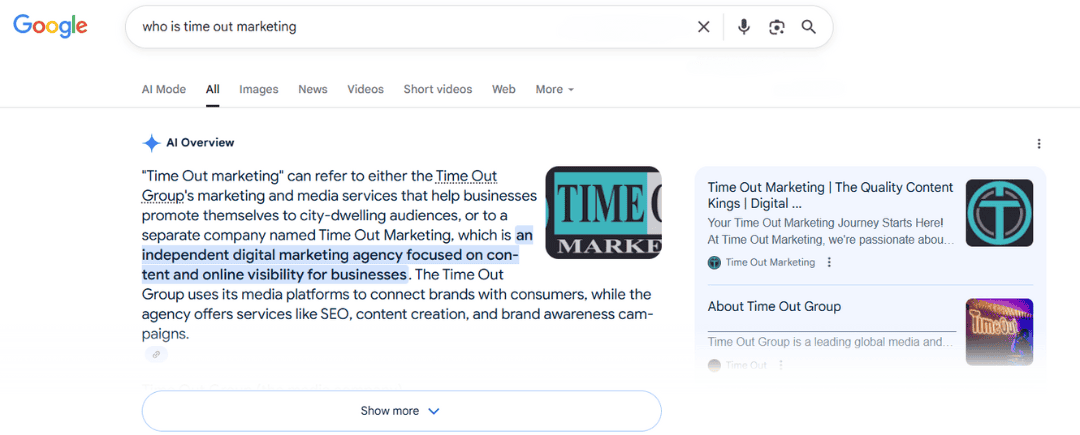
who is time out marketing AI overview

Authority Signals and Credibility

To build trust and relevance in the AI-dominated search landscape, your content needs more than just quality; it needs credibility:

  • AI Overviews are rising: As of March 2025, 13.14% of Google queries triggered an AI overview, up from just 6.49% in January.
  • Screen dominance is growing: On desktop, AI Overviews and Featured Snippets together can occupy over two-thirds of the visible search screen, up to 75.7% on mobile.
  • CTR declines are sharp: CTRs have dropped by up to 30%, despite a 49% rise in Google search impressions.

By featuring data-driven insights, your content demonstrates depth and keeps readers and AI systems engaged.


How Does Generative AI Affect Search?

Generative AI is reshaping search at a deeper level than just summaries. It’s changing user behavior and the way businesses approach SEO.

  • For users: Search feels more like a conversation than a list of results. People are relying on AI tools for guidance, recommendations, and context, not just facts.
  • For businesses: SEO is becoming less about ranking for a single keyword and more about building topic authority. The brands that consistently demonstrate expertise and trustworthiness will have the advantage as AI chooses which sources to cite.

In short, generative AI is shifting search from being transactional (keywords in, clicks out) to being contextual and trust-driven.

How to future proof your content

How to Future-Proof Your Content

At Time Out Marketing, we’ve already guided clients through adapting to AI-generated search results. In this shifting landscape, your content must help AI systems understand, trust, and prioritize your work. That means:

  • Build topic authority: Instead of chasing individual keywords, create clusters of content around a theme to establish expertise.
  • Use structured data: Schema markup, FAQ sections, and how-to formats help AI understand your content better.
  • Optimize for E-E-A-T: Demonstrate Experience, Expertise, Authoritativeness, and Trustworthiness across your site.
  • Go deep: Thin, surface-level articles won’t cut it. AI tools prioritize comprehensive, well-researched content.


How to Adapt Your Strategy for the AI Era

Strong foundations are only half the story. You also need to think about how your content is executed and distributed in an AI-driven landscape:

  • Formatting matters: Use bullet points, subheadings, and Q&A structures to make your content snippet and AI-friendly.
  • Diversify traffic sources: Don’t rely solely on Google. Build stronger email lists, leverage social channels, and explore partnerships.
  • Balance human and AI: AI can help with research and drafts, but strategy, creativity, and storytelling still need a human touch.
  • Repurpose content: One blog can become a LinkedIn carousel, a short-form video, or even a downloadable checklist. Content repurposing maximizes your reach.
Thriving in the Age of AI and Generative Search

Thriving in the Age of AI and Generative Search

AI and generative search aren’t killing SEO; they’re reshaping it. The focus is shifting from chasing individual keywords to creating intent-driven, authoritative, and structured content that works for both people and machines.

Marketers who embrace these changes early, adapt their strategies, and focus on quality and authority will stay ahead of the competition.

Curious how ready your content is for the AI era? Contact us today, and let’s future-proof your content strategy together.

Are You Ready to Take Time Out?

Let’s create strategies that deliver real results for your business.

Maximize Your Marketing Assets Through Content Repurposing

Maximize Your Marketing Assets Through Content Repurposing

Content Repurposing

Content creation can feel like a never-ending treadmill. As soon as you publish one blog post, there’s pressure to produce the next. But what if you didn’t always have to start from scratch? That’s where content repurposing comes in: a smart, time-saving strategy to get more value from everything you create.

Content repurposing is one of the most effective methods modern marketers have in their arsenal. In this blog, we’ll break down what content repurposing is, why it matters, and how to implement it effectively.


What Is Content Repurposing?

Content repurposing involves adapting existing content into various formats for different platforms. It’s not about copying and pasting the same message repeatedly. It’s about reimagining content in a way that suits the unique needs and behaviors of different audiences across different platforms.

For example:

  • A long-form blog post can become a series of bite-sized social media graphics.
  • A webinar can be turned into a podcast episode or blog summary.
  • A collection of tips can become a downloadable checklist or infographic.

Instead of constantly creating new content, you amplify what you already have. This approach builds on your existing assets, strengthens your SEO structure, and enhances internal linking opportunities. By strategically repurposing content, you can create a cohesive content cluster of related topics that signal authority to search engines while providing a richer experience for your audience.

Content Repurposing: why it matters

Why Content Repurposing Matters

Creating high-quality content takes time, money, and energy. But unfortunately, a single post or video often gets buried quickly in a content-saturated world. Repurposing content allows you to maximize your investment.

Here’s why content repurposing is a must for modern marketers:

1. Saves Time and Resources

You’ve already done the heavy lifting, researching, writing, filming, or designing. Repurposing lets you stretch that effort further.

2. Increases Reach and Engagement

Not everyone consumes content the same way. Some prefer videos, others love infographics or how-to articles. Repurposing helps you meet your target audience where they are.

3. Boosts SEO

Every new format or distribution channel is another opportunity to rank for keywords and generate backlinks. Companies that blog consistently receive 55% more website traffic than those that don’t.

4. Extends the Life of Your Best Content

Have a blog post that performed well two years ago? Update it, repurpose it, and reintroduce it to a new audience.


How to Turn One Blog Post Into 10 Pieces of Content

Let’s say you’ve written a blog titled Making Waves with  Email Marketing.” Instead of letting it sit as a one-off, you can repurpose it into a variety of social media posts and other valuable content formats, such as:

  1. A LinkedIn carousel showcasing the benefits of email marketing, with each slide dedicated to a distinct advantage.
  2. X (formerly Twitter) thread summarizing key statistics and insights from the blog, including projected daily email volumes.
  3. Instagram Reel featuring a quick tip on building a quality email list, emphasizing its long-term value.
  4. Email newsletter summarizing the blog’s main points and linking back to the full article for more in-depth reading.
  5. YouTube video discussing the evolution of email marketing and its current significance in digital marketing strategies.
  6. Podcast episode exploring the challenges of email marketing and strategies for overcoming them, as outlined in the blog.
  7. Infographic for Pinterest visually presenting the benefits of email marketing in an easy-to-digest format.
  8. Downloadable checklist titled “Email Marketing Essentials,” derived from the blog’s insights, for lead generation purposes.
  9. Webinar or live Q&A session discussing how to implement email marketing strategies to boost ROI effectively.
  10. Guest blog post on a partner site, offering a condensed version of the original blog with a link back to the full article.

That’s one blog transformed into ten valuable touchpoints; each helping you expand your reach, especially across social media, without having to start from scratch.

How to Repurpose Content The Smart Way

Here’s a quick step-by-step process to repurpose content:

1. Audit Your Existing Content

Examine your top-performing content, based on traffic, shares and conversions. These are goldmines for repurposing. Use tools like Google Analytics or SEMrush to find your most valuable assets.

2. Identify Opportunities by Format and Platform

Match your content to the right platform. A how-to blog might do well as a YouTube tutorial. A data-heavy article could be effectively presented as a LinkedIn infographic.

3. Tailor Your Message for Each Channel

Don’t just repost, adapt. Instagram needs visuals. LinkedIn thrives on professional insights. X demands short and concise messaging.

4. Create a Repurposing Calendar

Plan when and where each piece will be published to ensure consistency across platforms.

5. Track Performance and Optimize

Repurposing isn’t a one-and-done deal. Monitor engagement, clicks, and conversions. Then tweak your approach accordingly. And repurpose again where viable.


Tools That Make Content Repurposing Easier

Here are some tools to assist in the process:

    • Canva: Great for turning blog content into social graphics.
    • Descript: Ideal for repurposing video and audio.
    • ChatGPT: Useful for summarizing and reformatting content.
    • Hootsuite: For scheduling repurposed content across channels.
Content Repurposing 3

Common Mistakes to Avoid

Although repurposing is efficient, it must be done correctly. Here are some pitfalls to watch out for:

  • Ignoring context: What works on LinkedIn may flop on Instagram. Tailor each message to suit the platform and audience.
  • Not updating outdated information: If the original content is outdated, refresh it before repurposing, especially when figures and statistics are involved.
  • Over-automation: Don’t rely solely on tools. Human judgment still matters. Make it feel humanlike, and not robotic.


Work Smarter, Not Harder to Repurpose Your Content

Content repurposing is one of the smartest moves you can make as a marketer. It enables you to do more with less, reach a wider audience, and maximize the impact of your high-performing content for your brand.

So, before you rush to create something new, ask yourself: What do I already have that I can repurpose today to give it a new life?


Ready to Get More From Your Content?

At Time Out Marketing, we help brands build smarter strategies, starting with content you already own. Whether it’s blog-to-social transformations or video-to-article repackaging, our team can help you repurpose with purpose.

Contact us today to discover how we can help you optimize your content marketing assets as part of our comprehensive digital marketing strategies.

Are You Ready to Take Time Out?

Let’s create strategies that deliver real results for your business.

The Impact of AI Overview on Search Results

The Impact of AI Overview on Search Results

AI Overview

Artificial intelligence (AI) is transforming industries, and search engines are at the forefront of this evolution. As the internet expands, AI has become essential in refining how search engines operate, enhancing accuracy, relevance, and user experience. One significant outcome is the emergence of the AI overview, which reshapes how search results are generated and displayed.

In this blog, we’ll break down what an AI overview means in the context of search, how it functions, and the ways it’s transforming how we discover information online. Whether you’re a digital marketer or a search engine optimization (SEO) strategist, understanding AI’s growing influence on search results is essential.


What is the AI Overview in Search?

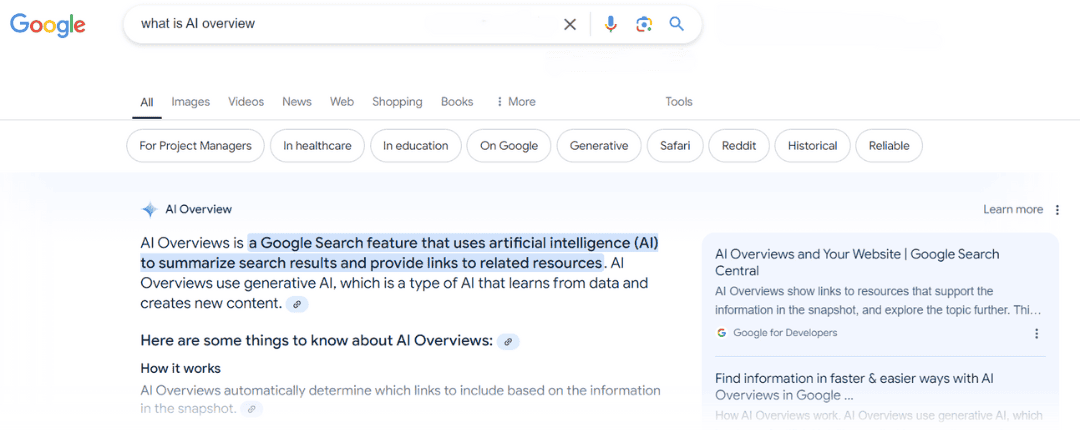
The term “AI overview” refers to how search engines utilize artificial intelligence to deliver more efficient, intuitive, and user-focused results. By analyzing data in real-time, AI interprets user intent and predicts what users are likely looking for based on search patterns and behavior. Generative AI, powered by advanced machine learning, enhances this by generating responses, snippets, and relevant information tailored to user queries, even for complex or less common searches.

Rather than relying solely on keywords, AI processes contextual information—such as how queries are phrased, device types, location, and even the time of day—to provide personalized, relevant results. Essentially, AI learns to refine the search process to make it more accurate and effective for each user, often solving the problem of irrelevant search results by understanding the context better.

What is AI Overview in Search

Global Availability of AI Overview in Search

The AI overview feature in Google is widely available in many countries. Still, its availability can vary depending on local regulations, the maturity of AI technologies in specific regions, and user adoption.

Google’s AI-powered features, such as featured snippets, Knowledge Graphs, and AI-driven recommendations, are generally available globally, including in countries like the United States, the United Kingdom, Canada, Australia, and across Europe and parts of Asia.

However, newly advanced AI features, like Generative AI-based search summaries and conversational AI search (e.g., Google Gemini, formerly Bard), often roll out in specific regions, like the US, before expanding to other countries. This gradual release is standard for cutting-edge AI technologies as they are tested and optimized for wider global usage.

The availability of AI overview in certain countries may also be influenced by:

  • Local laws regarding data privacy (e.g., GDPR in Europe)
  • Censorship or internet regulations, as in countries like China
  • Adoption of Google’s newer AI systems, which could take time to launch globally


How AI Has Evolved in Search Engines

To understand the full impact of AI in search engines, it’s important to look back at how search engines have evolved. In the early days, search engines used simple keyword matching to deliver results. If you typed in “best pizza restaurants,” the search engine would match websites that contained those exact words.

Now, with AI-driven algorithms like Google’s RankBrain and BERT (Bidirectional Encoder Representations from Transformers), search engines can understand the meaning behind the words. RankBrain, for example, uses machine learning to process unfamiliar queries, while BERT enables Google to better understand context, especially in longer or more conversational searches. These systems allow search engines to move beyond keyword matching, delivering results based on the whole meaning of the query.

How does AI Overview work

How Does AI Overview Work?

At its core, an AI overview analyzes huge amounts of data and learns from user interactions to better anticipate what users want. AI algorithms collect and process information from previous searches, user behavior, and other signals to deliver more relevant search results. AI-powered generative models can also support this by generating relevant content snippets based on a user’s query.

For example, if you search for “best vacation spots,” AI overview doesn’t just look for pages with the term “vacation spots.” Instead, it evaluates your search history, location, preferences, and even the time of year to offer more targeted suggestions. It might prioritize tropical destinations in winter or suggest trending locations based on current events.

AI also works to display search results in the most helpful way possible. Google, for instance, uses AI to power its Knowledge Graph, which provides quick facts and answers directly in the search results. This is part of the AI overview process, where search engines aim to present summarized, easily digestible information right at the top, reducing the need to click through multiple websites.


Impact on Clicks: The Rise of Zero-Click Searches

One of the consequences of AI Overview providing immediate answers is the rise of “zero-click searches,” where users get the information they need directly from the SERPs (search engine results pages) without having to click on a website. While this enhances user experience by delivering quick answers, it can significantly reduce website traffic, as fewer users feel the need to visit individual pages.

For SEO professionals, this shift means evolving strategies to ensure content is optimized for featured snippets and other elements on the SERPs. High-ranking content must still compete for visibility in these AI-driven results, maintaining its relevance despite fewer clicks. Creating quality content that directly aligns with user intent and meets the needs of the SERP layout is crucial for ongoing success.

Getting an AI Overview on Google

If you’ve used Google recently, you’ve likely encountered AI-driven features without realizing it.

Here’s how to get an AI overview on Google:

1. Perform a search – Type or speak your query into Google, whether it’s a short, specific search or a longer, conversational one.

2. Explore featured snippets – The box of information that appears at the top of the search results is powered by AI. This snippet quickly answers your question, often pulling data from a high-ranking website.

3. Utilize voice and visual search – Google’s AI allows users to perform voice searches using Google Assistant or search via images using Google Lens. This is an increasingly popular way to get an AI-driven overview without typing anything.

The AI overview filters and presents the most relevant information, streamlining your search experience. For users, this means less time scrolling through irrelevant links and more immediate access to what they need.

AI Overview example

Personalized Search Results

One of the most significant ways AI impacts search results is through personalization. AI tailors results based on each user’s preferences, browsing history, location, and even their device. This means that two people searching for the same thing may get different results.

For instance, searching “restaurants near me” will deliver different results depending on your location. AI uses your location to present nearby options. But it goes deeper than just location-based searches. Over time, AI learns more about your preferences based on what you click on, which types of articles you read, and what you tend to avoid.

This personalization enhances the overall user experience, delivering relevant information faster. However, it also raises concerns about privacy, as some users may not want search engines tracking their every move to tailor results.


Voice Search and Conversational AI

Voice search is another area where AI has had a profound impact. With the rise of voice assistants like Google Assistant, Siri, and Alexa, more people are asking their devices for information rather than typing queries into a search bar.

AI’s ability to understand natural language through conversational AI is crucial here. Instead of searching for “weather New York,” a user might say, “What’s the weather like in New York today?” The AI processes the query, understands the context, and delivers an accurate result.

Voice search often works hand-in-hand with the AI overview, providing direct answers to questions without users needing to scroll through multiple results. This makes voice search particularly valuable for users on the go, further demonstrating the power of AI in streamlining searches.


Visual Search: The Next Frontier

In addition to voice search, AI is also driving visual search capabilities. Tools like Google Lens allow users to search using images instead of text. For example, if you take a photo of a plant or a piece of furniture, AI can identify the object and present relevant information, such as where to buy the item or how to care for the plant.

AI plays a critical role in refining visual search results by recognizing objects and understanding their context. This area has significant growth potential, especially in industries like retail and e-commerce, where visual search can drive sales and improve customer experiences.

Google lens example

SEO Strategies in an AI-Driven Search Landscape

As AI-driven search engines continue influencing the digital landscape, SEO strategies must evolve to stay effective. Rather than relying on keywords alone, AI-driven content creation is pivotal in ensuring that content resonates with users and meets their needs. Additionally, the evolution of AI-driven search results prioritizes content aligned with user intent over keyword-stuffed pages.

To succeed in this environment, SEO professionals should focus on the following key strategies:

  • Intent-Based Content: Create content that addresses the underlying intent behind queries, not just the keywords themselves. For example, answering questions directly in your content can improve your chances of appearing in featured snippets or other AI-driven results.
  • Structured Data: Use schema markup to help search engines better understand the content on your site, increasing the chances of being featured in AI-generated snippets. This structured approach aids in delivering clear and concise information to users.
  • Voice and Visual Search Optimization: As AI enhances voice and visual search, ensure your content is optimized for natural language queries and image-based searches. This means focusing on conversational keywords and visual elements that match user intent.
  • User Experience and Engagement: Prioritize creating high-quality, relevant content that serves user needs. By leveraging AI tools to track user behavior and trends, marketers can gain new insights into what content will perform best and when to deliver it.

By aligning with these strategies, SEO professionals can ensure their content performs well in the AI-driven search landscape and meets the evolving demands of users.

What's next for AI

What’s Next for AI and Search Results?

Looking forward, the future of AI in search results is promising. We can expect further advancements in personalization, making search experiences even more tailored to individual users. Voice and visual search will likely continue to grow, integrating more seamlessly with AI technologies.

In addition, AI-driven content creation will become increasingly sophisticated, enabling search engines to provide even more relevant, context-aware content that meets user needs. This will streamline the user experience and allow marketers to produce content optimized for search engines.

However, as AI becomes more sophisticated, ethical considerations must also be addressed. Issues like algorithmic bias, data privacy, and transparency in AI processes are vital to ensure that AI-enhanced search results are fair, unbiased, and respectful of user privacy.


Adapting to AI-Driven Search

The impact of AI on search results is undeniable. From personalized experiences and voice search to visual search and AI-powered SEO, AI is reshaping the way we find information online. As search engines continue to evolve, staying informed about these changes is crucial for marketers and professionals looking to stay ahead in the digital space.

The AI overview has made search results more efficient, intuitive, and tailored to individual needs. As AI technology continues to advance, the way we search, find, and interact with information will only become more innovative and refined.

To climb search engine rankings, it’s important to remember that as AI scans high-ranking pages, content quality remains paramount. Your SEO strategy must adapt to meet these evolving demands, focusing on creating valuable, relevant content for your audience.

Ready to elevate your digital presence? Contact us today, and let us help you create a customized SEO strategy tailored to the AI-driven search landscape.

Are You Ready to Take Time Out?

Let’s create strategies that deliver real results for your business.