AI Search and Visibility: Why Content Still Matters for SEO

AI Search and Visibility: Why Content Still Matters for SEO

AI Search and Visibility

AI Search is changing how people discover information online. However, quality content still matters for SEO because it allows websites to be found, understood, and referenced by both search engines and AI-powered systems.

In the past, SEO success was defined by rankings, backlinks, and keyword optimization. While those fundamentals still matter, the way people access information is evolving. Increasingly, users are turning to AI-driven search experiences and LLMs (Large Language Models) that summarize answers rather than simply listing websites.

This shift has raised an important question for marketers and business owners: Does content still matter in an AI-driven search world?

The short answer is yes, more so than ever. But the role of content has evolved.


Understanding AI Search and Its Impact on Visibility

AI Search refers to search experiences powered by artificial intelligence, where users receive direct, conversational answers rather than just a list of blue links. These systems may pull from search indexes, training data, or live web sources to generate responses.

This changes how visibility works. Instead of competing only for rankings on Google search engine result pages (SERPs), businesses now compete for:

  • Inclusion in AI-generated answers
  • Citations within summaries
  • Authority signals that influence AI trust
  • Relevance across broader topic clusters rather than single keywords

Visibility is no longer just about being on page one. It’s about being recognized as a reliable source that AI systems can confidently reference.

In many ways, AI Search and AI Visibility are two sides of the same coin. The easier it is for AI systems to find, understand, and trust your content, the more likely your business is to appear in AI-generated responses.

Why Content Still Matters for SEO

Why Content Still Matters for SEO in an AI Search World

Despite the rise of AI Search, content remains the foundation of online visibility for one simple reason: AI systems still rely on content to learn, evaluate, and respond.

Whether it’s traditional search engines or AI models, they all depend on structured, high-quality information published across the web.

If your website does not contain the answers people are searching for, there is nothing for search engines or AI systems to interpret, rank, or reference.

Content performs three essential roles:

1. Helps search engines understand your relevance

Search engines still rely heavily on text-based signals to understand what a page is about. Well-written, structured content helps algorithms categorize your pages correctly and match them to user intent.

2. Provides the raw material for AI responses

AI systems generate answers by drawing from trusted sources. If your content is clear, authoritative, and well-structured, it is more likely to be used in those responses.

3. Builds authority over time

Consistent, high-value content builds topical authority. This signals to both search engines and AI models that your website is a reliable source within your niche.

Without content, visibility is not possible.


How AI Systems Use Content to Determine Visibility

While the exact algorithms vary, most AI search experiences rely on a combination of:

  • Indexed web data
  • Semantic relevance
  • Authority indicators
  • Content clarity and structure

Unlike traditional SEO, where a page might rank based on keyword optimization, AI systems prioritize content that is:

  • Easy to interpret
  • Factually consistent
  • Contextually rich
  • Directly aligned with user intent

This means thin, vague, or overly optimized content is far less likely to be referenced. In contrast, content that clearly explains a topic is much more likely to be included in AI-generated answers.

The Evolution of SEO: From Keywords to Context

SEO has shifted from keyword matching to meaning and search intent. While keywords like AI search still matter, modern SEO focuses on:

  • Topical depth over single-page optimization
  • User intent over exact-match keywords
  • Semantic relationships between concepts
  • Content quality and clarity over volume

This is why content strategy is central to SEO performance. A website that publishes shallow, keyword-focused articles will struggle to compete with one that provides in-depth, useful, and well-structured information.


What High-Performing Content Looks Like Today

In an AI search environment, strong content typically shares a few key characteristics:

  • Answers questions clearly and directly: Users and AI systems value content that is direct and provides useful information.
  • Demonstrates expertise: Content should show understanding, not just repetition.
  • Covers topics comprehensively: Rather than focusing on a narrow keyword, strong content explores related ideas and subtopics.
  • Is structured logically: Clear formatting with headings, sections, and flow improves readability and machine interpretation.
  • It aligns with search intent: Whether informational, commercial, or comparative, content must match what the user is trying to achieve.

These factors improve both SEO performance and AI visibility.


Common Mistakes Businesses Still Make

Even as SEO evolves, many businesses continue to approach content the old way. Some of the most common mistakes include:

1. Writing for keywords instead of people

Over-optimized content often fails to engage users and is less likely to be trusted by AI systems.

2. Publishing thin or generic content

Low-value pages are unlikely to rank or be cited, no matter how well they are optimized.

3. Ignoring content depth

Surface-level content struggles to build authority in competitive spaces.

4. Treating SEO and content separately

They are fully integrated and work together as a duo.

5. Relying on outdated content

Outdated content loses relevance as search engines and AI systems prioritize fresh information.

6. Having no content at all

Without content, there is nothing for search engines or AI systems to index or reference, making visibility impossible.

Avoiding these mistakes is key to long-term visibility.

The Future of AI Search and Content Visibility

The Future of AI Search and Content Visibility

As AI search evolves, the importance of high-quality content is increasing rather than decreasing. Search engines and AI systems will continue prioritizing sources that:

  • Provide accurate information
  • Demonstrate authority
  • Offer depth and clarity
  • Consistently publish high-quality content

In other words, the fundamentals of SEO are not disappearing; they are being amplified.

Visibility is no longer just about ranking positions. It is about being part of the answer itself.


Why Quality Content Remains the Foundation of SEO

AI Search is reshaping how people find information online, but quality content remains the foundation of SEO. Without valuable, structured, and authoritative content, websites will struggle to achieve visibility in both traditional search and AI-generated results.

For businesses, the message is clear. Invest in content that informs, educates, and builds authority. That is what drives long-term visibility in both search engines and AI-powered platforms.

While the technology behind search continues to evolve, one principle remains unchanged: content is king. Quality content is what helps your business get found, trusted, ranked, and referenced.

Want to improve your content strategy for AI search and SEO? Contact us today to start building content that gets found, ranked, and referenced.

FAQs

What is AI Search?

AI Search refers to search systems that use artificial intelligence to generate direct answers to user queries rather than displaying traditional lists of search results.

Does SEO still matter with AI search?

Yes. SEO remains essential because AI systems rely on indexed, structured web content to generate responses and identify authoritative sources.

Why is quality content important for SEO?

Quality content helps search engines understand relevance, improves user engagement, and increases the likelihood of being cited in AI-generated answers.

How does AI decide what content to show?

AI systems consider relevance, authority, clarity, structure, and how well content answers user intent when selecting sources for responses.

Is keyword optimization still important?

Yes, but it is no longer the sole focus. Modern SEO prioritizes topic depth, intent, and content quality over exact keyword matching.

Is Your Evergreen Content Ready for AI Search?

Is Your Evergreen Content Ready for AI Search?

Evergreen Content Ready for AI Search

AI search is transforming how people find information online. With Google launching AI Overviews, Bing adding Copilot, and new competitors like Perplexity offering conversational answers, the search world is changing quickly. For marketers, this means a shift in how content is discovered, summarized, and recommended.

Evergreen content has always been a key part of digital marketing. It regularly drives traffic, boosts authority, and answers questions long after it’s published. But the question now is: Is your evergreen content ready for AI search?

This blog discusses how to audit, optimize, and update evergreen content to keep it visible in AI-driven search results. You’ll learn how to structure posts for snippets, optimize for question-based queries, and write in a way that AI models prioritize.


What Does Evergreen Content Mean?

Evergreen content includes articles, guides, or resources that stay relevant over time. Think of it as sustainable content. This type of timeless content isn’t tied to trending topics but instead provides content with lasting value that continues to attract an audience and search traffic. Therefore, making your business site important for people who research a specific topic.

Studies show that businesses that blog regularly see a 55% increase in website visitors, highlighting the value of consistent, high-quality content. This steady traffic benefits your readers, enhances your site’s performance in search engines, and can even support your social media presence by providing shareable content.

Examples of evergreen content include:

  • How-to guides and tutorials
  • FAQs or explainer posts
  • Industry glossaries or definitions
  • Best practices and strategy guides
Is Evergreen Content Good for SEO

Is Evergreen Content Good for SEO?

The value of evergreen content lies in its longevity, offering lasting SEO advantages and increasing its relevance for search engines. A well-written post can generate organic visits for years while earning backlinks and engagement that boost your site’s authority.

Unlike trend-based content that peaks quickly, evergreen content creates a foundation for long-term visibility. In today’s AI-first search world, that foundation matters more than ever. Evergreen content needs more than just staying power; it requires clarity, freshness, and adaptability to remain visible in AI-driven search results.


How to Optimize Content for AI Search?

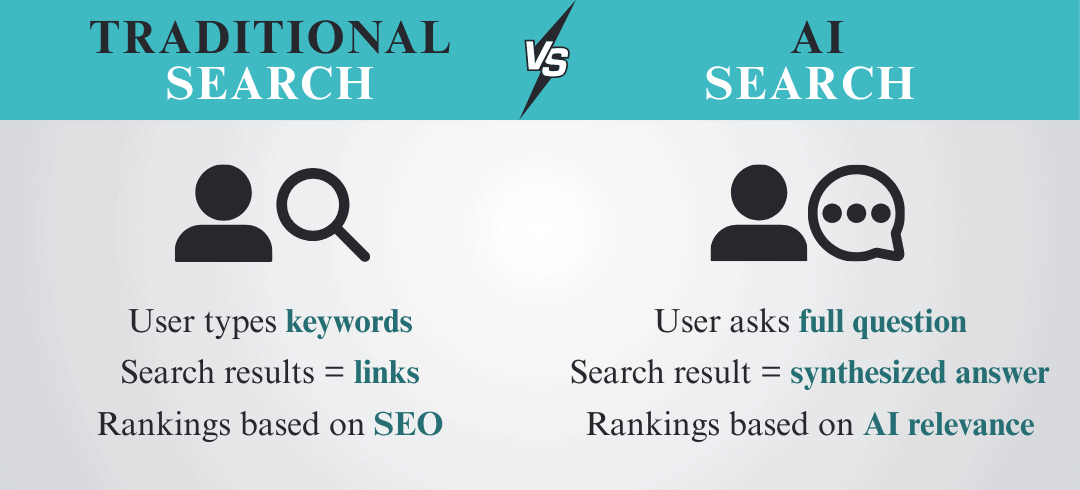
AI search operates differently from traditional results. Instead of showing a list of links, AI usually produces a synthesized answer that combines information from multiple sources. To stay part of that conversation, your content must be:

  • Structured clearly for machine readability
  • Concise and direct for quick summaries
  • Up-to-date, so it remains credible
  • Semantically rich so AI models can understand the context

The goal is no longer just ranking on the first page of Google’s search results. Instead, it’s about ensuring your evergreen content piece is selected for AI snippets and overview answers.

Traditional Search vs AI Search

How to Get Your Evergreen Content Ready for AI Search: Step-by-Step

To put this into practice, here are five practical steps to ensure your evergreen content remains visible and effective in an AI search world.


Step 1: Audit Your Evergreen Content for AI Visibility

Before you begin optimizing, assess what you currently have. Auditing helps you determine which posts are still effective and which ones need improvement.

How to run an audit:

  1. Check traffic and rankings: Use Google Search Console to see which evergreen pieces are still generating impressions.
  2. Test AI visibility: Run queries in Google AI Overviews or ChatGPT to see if your content is being referenced.
  3. Benchmark competitors: Identify who is winning AI snippets for your target keywords.

This process shows where your evergreen content is lagging. From there, you can focus on updates and improvements.


Step 2: Structure Content for AI Overviews and Snippets

AI models prefer content that’s easy to analyze and summarize. A lengthy block of text won’t work. Instead, organize your content clearly.

Best practices:

  • Use headings (H2, H3) to break content into logical sections.
  • Summarize key points in bullet lists or numbered steps.
  • Answer questions directly within the first few sentences of a section.
  • Add schema markup like FAQ or How-To where appropriate.

For example, if you write a post titled “How AI and Generative Search Are Changing Content Strategy,” don’t bury the answer. Start by clearly summarizing the key insights from the introduction, highlighting how AI affects content discovery and structuring, so both readers and AI models instantly understand its value.

Step 3: Optimize for Question-Based Search

AI search thrives on conversational queries. People are asking full questions rather than typing short keywords, and AI tools are trained to answer them.

How to adapt your evergreen content:

  • Add an FAQ section at the end of your post.
  • Use natural language questions as subheadings.
  • Include long-tail keywords like ‘Content Marketing Strategies to Drive Leads’ instead of only targeting ‘Content Marketing Strategies.’
  • Provide both short answers and expanded explanations.

Think of it this way: if a user asks an AI tool a direct question, your content should include the exact phrasing and the best possible answer.


Step 4: Refresh Outdated Evergreen Posts

Even the most evergreen content must be refreshed to maintain content with ongoing relevance in AI-powered SERPs. AI systems reward updated content because they aim to provide accurate and current information.

Ways to refresh evergreen content:

  • Update statistics, research, and examples with the latest data.
  • Replace outdated screenshots, tools, or references.
  • Add new insights that reflect current industry trends.
  • Re-check internal and external links to avoid broken references.

For example, a post written in 2020 about “SEO best practices” should be updated to include AI-driven search in 2025. Without updates, AI models may overlook your content and instead surface newer sources.

Semantic Clarity

Step 5: Write with Semantic Clarity and Concise Answers

AI tools don’t just look for keywords; they analyze meaning. That’s why semantic clarity is critical.

Tips for writing AI-ready content:

  • Be concise. Short, direct sentences are easier for AI to process.
  • Use semantic variations. If your focus keyword is ‘evergreen content,’ include related terms such as timeless content, sustainable content, content with lasting value, content with ongoing relevance, and long-term content assets.
  • Avoid jargon overload. Clarity beats complexity.
  • Balance depth with skim ability. Offer detailed insights but keep them easy to digest.

This way, content attracts both human readers and AI algorithms.


Optimizing Today, Creating for Tomorrow

Evergreen content continues to be one of the most powerful long-term content assets in your content marketing strategy. In the age of AI search, it must adapt to attract readers and perform well in AI-powered results. By auditing existing posts, structuring them for snippets, optimizing for questions, updating outdated content, and writing with semantic clarity, you ensure your content is both SEO-friendly and AI-ready.

Not sure where to start? Contact us today. We’ll help you optimize existing content and create new resources so your evergreen content is ready for AI search, keeping your brand visible in a changing search landscape.

FAQs

What is evergreen content?

Evergreen content is content that remains relevant over time, providing lasting value to readers. Examples include how-to guides, FAQs, industry glossaries, and best practice guides.

Why is evergreen content important for my business?

Evergreen content drives consistent traffic, boosts authority, improves search engine rankings, and supports social media sharing. Businesses that blog regularly see more website visitors than those that don’t.

How does evergreen content help with SEO?

Evergreen content generates ongoing visits, backlinks, and engagement, signaling relevance to search engines. It provides a lasting foundation that can also be leveraged in AI-powered search features, such as snippets, overview answers, and conversational responses.

How can I optimize evergreen content for AI search?

Structure your content clearly with headings, bullet points, and concise summaries. Include semantic variations, answer common questions directly, and keep content up-to-date to remain credible for AI-driven search results.

How often should I update evergreen content?

Even evergreen content should be refreshed periodically. Update statistics, examples, tools, and industry trends to maintain relevance and ensure AI systems consider your content accurate and current.

Can evergreen content improve my social media presence?

Yes. Shareable, high-value evergreen content can support your social media strategy by providing valuable resources your audience will engage with, driving traffic back to your site.

What is semantic clarity, and why does it matter for AI?

Semantic clarity means writing in a way that clearly communicates the meaning of your content. AI models analyze meaning, not just keywords, so clear, concise, and context-rich writing increases the chances your content will be selected for AI summaries and answers.

Are You Ready to Take Time Out?

Let’s create strategies that deliver real results for your business.