The Rise of AI vs Human Creativity: Who Wins?

The Rise of AI vs Human Creativity: Who Wins?

The Rise of AI

Artificial intelligence (AI) is everywhere. From chatbots and image generators to automated content creation tools, AI technology is transforming industries at a rapid pace. But as AI grows more capable, a key question emerges: How does it measure up against human creativity?

In this blog, we explore the rise of AI in content creation and marketing, its strengths and limitations, and why human input remains vital. By the end, you’ll understand how to leverage AI effectively without losing the human touch that drives engagement, trust, and results.


What Started the Rise of AI?

The rise of AI didn’t appear overnight. Its roots stretch back to the mid-20th century, when computer scientists began exploring the science behind whether machines could mimic reasoning. Early breakthroughs in machine learning and natural language processing (NLP), such as the 1960s chatbot ELIZA, demonstrated that computers could understand and respond to language in new ways. Although limited at the time, it laid the foundation for future AI developments.

Progress was slow for decades, constrained by limited computing power and scarce access to large datasets. As neural networks developed and advanced algorithms became more sophisticated, AI gradually moved from theoretical experiments into practical research.

These foundational advances set the stage for today’s rapid development of AI, making it a game-changer for marketers and content creators.
Why Is AI Suddenly Booming

Why Is AI Suddenly Booming?

After decades of gradual progress, AI is now experiencing explosive growth. Several factors explain this sudden boom:

  1. Accessible Tools: Modern AI platforms like ChatGPT, DALL·E, and other deep learning models are available to businesses of all sizes. You no longer need a team of data scientists to experiment.
  2. Cloud Computing: Powerful cloud infrastructure allows AI models to process massive datasets at unprecedented speeds.
  3. Data Availability: With more digital data than ever before across the online world, AI systems can learn patterns and produce outputs that feel increasingly human-like.
  4. Rapid Innovation: AI companies continuously improve their models, making them faster, smarter, and easier to use.

Therefore, AI is booming because it promises speed, scalability, and efficiency, qualities that every business wants. But is that enough?


What AI Can Do

So, is speed, scalability, and efficiency really enough? AI excels at processing existing information and generating outputs based on patterns, making it a supercharged research and drafting assistant. Its key strengths include:

  • Content Generation: Text, blog posts, product descriptions, ad copy, and even SEO-friendly drafts can be created in seconds.
  • Data-Driven Insights: AI can analyze customer behavior, predict trends, and recommend strategies with incredible accuracy, including insights from search behavior, leveraging recognition patterns in data.
  • Automation: From scheduling emails to managing social posts, AI saves time and reduces human error.
  • Personalization: AI-driven algorithms allow businesses to tailor content and campaigns to specific audiences, boosting engagement and user experience.

These capabilities make AI an invaluable tool for marketers, particularly in terms of efficiency and scalability. However, while AI can accomplish a great deal, it still relies on humans to ensure quality, creativity, and strategic impact.

AI is like a racing car

What is the 30% Rule in AI?

A practical rule of thumb in AI-assisted content creation is the “30% rule.” It suggests that AI can autonomously handle roughly 30% of content production, while the remaining 70% requires human input, oversight, and creativity.

“AI is like a racing car: powerful, fast, and full of potential, but it’s only as good as the driver behind the wheel.”

This analogy highlights the key truth behind the 30/70 split: AI can draft, suggest, or scale content, but humans must review, refine, and inject originality. Without human guidance, AI-generated content risks being generic, off-brand, or factually inaccurate; a perfect segue into why humans remain essential.


What Humans Bring to the Table

While AI can analyze data and identify patterns, humans possess qualities machines cannot replicate:

  • Creativity: Fresh ideas, storytelling, and big-picture thinking are uniquely human traits.
  • Emotional Connection: Audiences respond to authenticity, empathy, and tone qualities AI can mimic but never truly feel.
  • Critical Thinking: Humans can evaluate context, cultural nuances, and ethical implications in ways AI cannot.
  • Brand Voice: Every brand has a personality. AI can follow style guides, but humans bring them to life.

In short, AI improves efficiency, but humans drive vision, strategy, and emotional connection. For marketers, this means utilizing AI to automate repetitive tasks, allowing human energy to focus on storytelling, strategy, and brand voice. These skills are non-negotiable; without them, content risks sounding robotic, generic, or irrelevant.

Where AI Falls Short

Despite its strengths, AI has clear limitations:

  • No Guaranteed Results: AI can draft content, but it doesn’t automatically generate leads or sales; success depends on human strategy.
  • Limited Emotional Intelligence: AI can mimic empathy or humor, but it cannot truly understand audience emotions.
  • Lack of Originality: AI relies on existing data and patterns; it cannot create entirely original ideas.
  • Context Blind Spots: It can misinterpret cultural nuance or industry-specific language.
  • Accuracy Risks: AI occasionally “hallucinates,” producing false or misleading information.
  • Ethical Concerns: Overreliance on AI raises questions about bias, copyright, and authenticity.
  • Data Dependence: AI is limited to the knowledge it’s trained on and cannot innovate beyond it.

These limitations reinforce one key point: AI is a tool, not a replacement. Human oversight ensures content remains original, relevant, and engaging, setting the stage for effective collaboration between humans and machines.

How Humans and AI Can Work Together

How Humans and AI Can Work Together

The most effective approach isn’t humans versus AI; it’s humans plus AI. By combining their strengths, businesses can maximize both efficiency and originality.

Here’s what that collaboration looks like in practice:

  • Drafting and Research: Let AI act as a support system to generate outlines or first drafts, including generating images, after which humans apply insight, creativity, and brand personality.
  • Refinement and Strategy: AI can analyze customer behavior, but humans turn those insights into meaningful, actionable campaigns.
  • Scaling with Quality: AI ensures content volume and consistency, while humans make sure it aligns with brand voice and audience expectations, particularly across media and digital channels.

This partnership leverages the best of both worlds. AI provides speed and data-driven efficiency, while humans bring creativity, judgment, and emotional intelligence. Therefore, producing content that is high-quality, original, and engaging in ways that neither could achieve on their own.

Is Human Intelligence a Thing of the Past

5 Tips for Using AI

If you’re using AI in your marketing or content strategy, here are five key tips to get the most out of it:

  1. Use AI as an Assistant, Not a Replacement: Let AI handle repetitive tasks, research, and drafts, but rely on human oversight for quality, creativity, and strategy.
  2. Maintain a Human Touch: Ensure all content reflects brand voice, storytelling, and emotional connection, elements only humans can provide.
  3. Review and Refine: Always edit AI-generated content to correct errors, enhance originality, and align with business goals.
  4. Leverage Data Wisely: Use AI to analyze search trends, analytics, and customer patterns insights to inform strategy, but make final decisions and creative choices yourself.
  5. Experiment and Adapt: Continuously test AI tools, workflows, and collaboration methods to find the right balance for your team and audience.

These practical tips help marketers combine the speed and scalability of AI with the creativity and judgment of humans, ensuring the content is both efficient and impactful.


Is Human Intelligence a Thing of the Past?

Despite all the hype, human intelligence and creativity are far from obsolete. While AI is powerful, it cannot replicate the depth of human creativity, emotion, or strategic thinking. The rise of AI isn’t a replacement; it’s an opportunity to empower humans to work smarter and more creatively.

Businesses that treat AI as a partner while continuing to invest in human insight and originality will achieve the best results. After all, people connect with people, not machines.

If you’re ready to leverage AI without compromising quality, contact us today to see how we can elevate your content strategy. Our team specializes in AI-assisted content creation that balances technology with human creativity, ensuring your content remains meaningful, engaging, and results-driven in a competitive digital landscape.

FAQs

What is the rise of AI?

The rise of AI refers to the rapid growth and widespread adoption of artificial intelligence technologies across various industries.

Can AI replace human creativity?

No. AI can assist with tasks, but human creativity, insight, and strategy remain essential.

How is AI changing marketing and content creation?

AI speeds up content creation, analyzes data, personalizes campaigns, and automates repetitive tasks.

What are the limitations of AI?

AI lacks true emotional intelligence, cannot generate entirely original ideas, may produce inaccuracies, and depends on existing data.

How can humans and AI work together effectively?

Humans guide AI by providing creativity, strategy, and brand voice, while AI handles research, drafting, and data analysis.

What practical tips help businesses leverage AI?

Utilize AI as an assistant, maintain a human touch, review outputs, leverage data effectively, and conduct continuous experimentation.

Why is the rise of AI happening now?

Advances in machine learning, NLP, cloud computing, and access to large datasets enable AI tools to become faster, smarter, and more widely available.

What industries are most impacted by the rise of AI?

Marketing, content creation, finance, healthcare, customer service, manufacturing, and SaaS are among the industries benefiting most from AI.

How does AI impact content marketing?

AI enhances efficiency by generating drafts, analyzing trends, and assisting marketers in tailoring campaigns.

What is the difference between AI and human creativity?

AI follows patterns and existing data, whereas human creativity generates original ideas and emotional insights.

Are AI tools suitable for small businesses?

Yes. Accessible AI platforms allow businesses of all sizes to streamline content creation and automate tasks.

Can AI write SEO-friendly content?

AI can generate SEO-friendly drafts, but humans must refine and optimize for context, relevance, and originality.

What are examples of AI in marketing today?

Chatbots, image generators, automated copywriting tools, and predictive analytics platforms are common examples of these technologies.

Is AI replacing jobs in creative industries?

AI assists with repetitive tasks, but humans remain crucial for strategic, creative, and emotionally engaging work.

How do I balance AI use with human input?

Follow a structured workflow: AI handles research and drafting, humans focus on creativity, strategy, and brand voice.

Are You Ready to Take Time Out?

Let’s create strategies that deliver real results for your business.
The Impact of AI Overview on Search Results

The Impact of AI Overview on Search Results

AI Overview

Artificial intelligence (AI) is transforming industries, and search engines are at the forefront of this evolution. As the internet expands, AI has become essential in refining how search engines operate, enhancing accuracy, relevance, and user experience. One significant outcome is the emergence of the AI overview, which reshapes how search results are generated and displayed.

In this blog, we’ll break down what an AI overview means in the context of search, how it functions, and the ways it’s transforming how we discover information online. Whether you’re a digital marketer or a search engine optimization (SEO) strategist, understanding AI’s growing influence on search results is essential.


What is the AI Overview in Search?

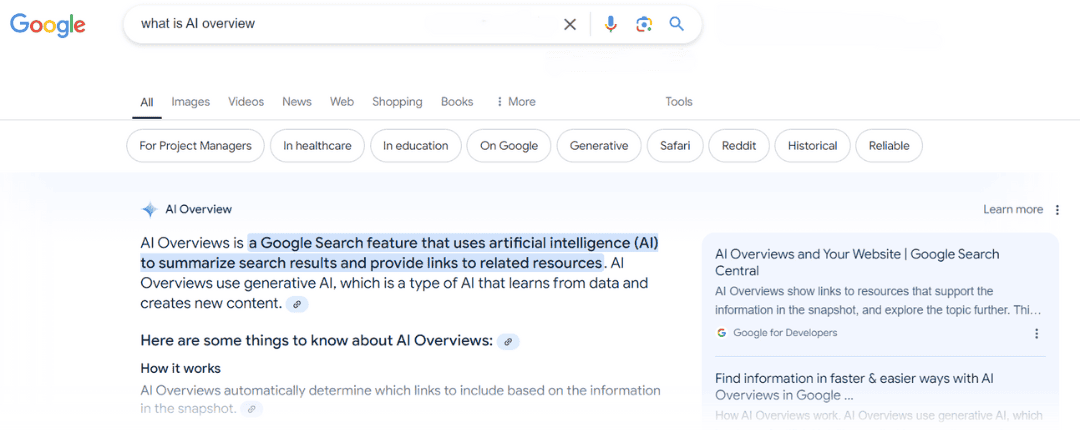
The term “AI overview” refers to how search engines utilize artificial intelligence to deliver more efficient, intuitive, and user-focused results. By analyzing data in real-time, AI interprets user intent and predicts what users are likely looking for based on search patterns and behavior. Generative AI, powered by advanced machine learning, enhances this by generating responses, snippets, and relevant information tailored to user queries, even for complex or less common searches.

Rather than relying solely on keywords, AI processes contextual information—such as how queries are phrased, device types, location, and even the time of day—to provide personalized, relevant results. Essentially, AI learns to refine the search process to make it more accurate and effective for each user, often solving the problem of irrelevant search results by understanding the context better.

What is AI Overview in Search

Global Availability of AI Overview in Search

The AI overview feature in Google is widely available in many countries. Still, its availability can vary depending on local regulations, the maturity of AI technologies in specific regions, and user adoption.

Google’s AI-powered features, such as featured snippets, Knowledge Graphs, and AI-driven recommendations, are generally available globally, including in countries like the United States, the United Kingdom, Canada, Australia, and across Europe and parts of Asia.

However, newly advanced AI features, like Generative AI-based search summaries and conversational AI search (e.g., Google Gemini, formerly Bard), often roll out in specific regions, like the US, before expanding to other countries. This gradual release is standard for cutting-edge AI technologies as they are tested and optimized for wider global usage.

The availability of AI overview in certain countries may also be influenced by:

  • Local laws regarding data privacy (e.g., GDPR in Europe)
  • Censorship or internet regulations, as in countries like China
  • Adoption of Google’s newer AI systems, which could take time to launch globally


How AI Has Evolved in Search Engines

To understand the full impact of AI in search engines, it’s important to look back at how search engines have evolved. In the early days, search engines used simple keyword matching to deliver results. If you typed in “best pizza restaurants,” the search engine would match websites that contained those exact words.

Now, with AI-driven algorithms like Google’s RankBrain and BERT (Bidirectional Encoder Representations from Transformers), search engines can understand the meaning behind the words. RankBrain, for example, uses machine learning to process unfamiliar queries, while BERT enables Google to better understand context, especially in longer or more conversational searches. These systems allow search engines to move beyond keyword matching, delivering results based on the whole meaning of the query.

How does AI Overview work

How Does AI Overview Work?

At its core, an AI overview analyzes huge amounts of data and learns from user interactions to better anticipate what users want. AI algorithms collect and process information from previous searches, user behavior, and other signals to deliver more relevant search results. AI-powered generative models can also support this by generating relevant content snippets based on a user’s query.

For example, if you search for “best vacation spots,” AI overview doesn’t just look for pages with the term “vacation spots.” Instead, it evaluates your search history, location, preferences, and even the time of year to offer more targeted suggestions. It might prioritize tropical destinations in winter or suggest trending locations based on current events.

AI also works to display search results in the most helpful way possible. Google, for instance, uses AI to power its Knowledge Graph, which provides quick facts and answers directly in the search results. This is part of the AI overview process, where search engines aim to present summarized, easily digestible information right at the top, reducing the need to click through multiple websites.


Impact on Clicks: The Rise of Zero-Click Searches

One of the consequences of AI Overview providing immediate answers is the rise of “zero-click searches,” where users get the information they need directly from the SERPs (search engine results pages) without having to click on a website. While this enhances user experience by delivering quick answers, it can significantly reduce website traffic, as fewer users feel the need to visit individual pages.

For SEO professionals, this shift means evolving strategies to ensure content is optimized for featured snippets and other elements on the SERPs. High-ranking content must still compete for visibility in these AI-driven results, maintaining its relevance despite fewer clicks. Creating quality content that directly aligns with user intent and meets the needs of the SERP layout is crucial for ongoing success.

Getting an AI Overview on Google

If you’ve used Google recently, you’ve likely encountered AI-driven features without realizing it.

Here’s how to get an AI overview on Google:

1. Perform a search – Type or speak your query into Google, whether it’s a short, specific search or a longer, conversational one.

2. Explore featured snippets – The box of information that appears at the top of the search results is powered by AI. This snippet quickly answers your question, often pulling data from a high-ranking website.

3. Utilize voice and visual search – Google’s AI allows users to perform voice searches using Google Assistant or search via images using Google Lens. This is an increasingly popular way to get an AI-driven overview without typing anything.

The AI overview filters and presents the most relevant information, streamlining your search experience. For users, this means less time scrolling through irrelevant links and more immediate access to what they need.

AI Overview example

Personalized Search Results

One of the most significant ways AI impacts search results is through personalization. AI tailors results based on each user’s preferences, browsing history, location, and even their device. This means that two people searching for the same thing may get different results.

For instance, searching “restaurants near me” will deliver different results depending on your location. AI uses your location to present nearby options. But it goes deeper than just location-based searches. Over time, AI learns more about your preferences based on what you click on, which types of articles you read, and what you tend to avoid.

This personalization enhances the overall user experience, delivering relevant information faster. However, it also raises concerns about privacy, as some users may not want search engines tracking their every move to tailor results.


Voice Search and Conversational AI

Voice search is another area where AI has had a profound impact. With the rise of voice assistants like Google Assistant, Siri, and Alexa, more people are asking their devices for information rather than typing queries into a search bar.

AI’s ability to understand natural language through conversational AI is crucial here. Instead of searching for “weather New York,” a user might say, “What’s the weather like in New York today?” The AI processes the query, understands the context, and delivers an accurate result.

Voice search often works hand-in-hand with the AI overview, providing direct answers to questions without users needing to scroll through multiple results. This makes voice search particularly valuable for users on the go, further demonstrating the power of AI in streamlining searches.


Visual Search: The Next Frontier

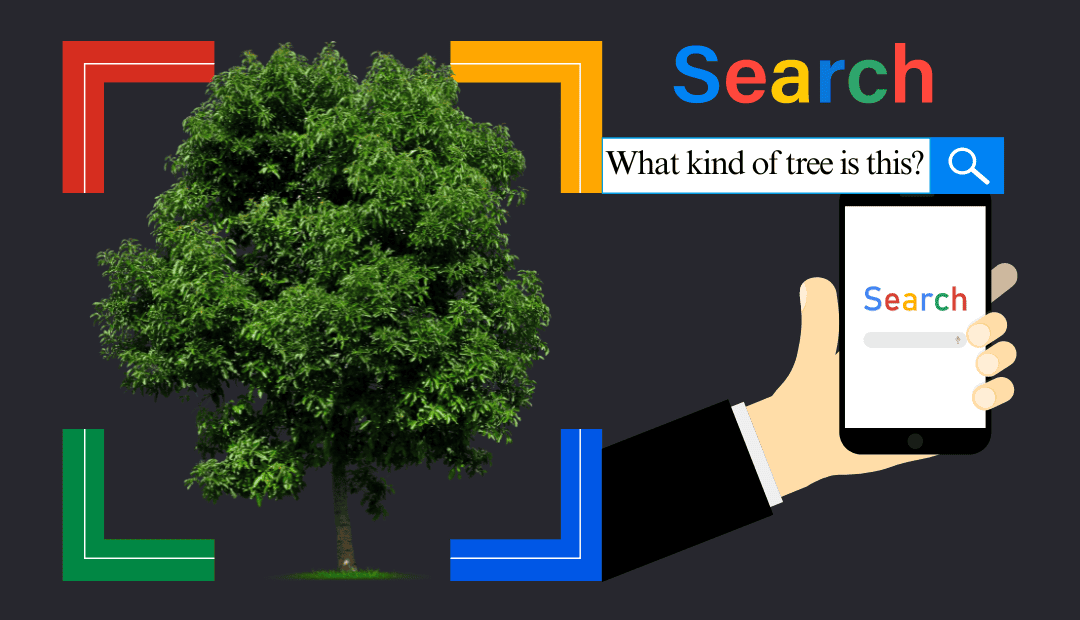
In addition to voice search, AI is also driving visual search capabilities. Tools like Google Lens allow users to search using images instead of text. For example, if you take a photo of a plant or a piece of furniture, AI can identify the object and present relevant information, such as where to buy the item or how to care for the plant.

AI plays a critical role in refining visual search results by recognizing objects and understanding their context. This area has significant growth potential, especially in industries like retail and e-commerce, where visual search can drive sales and improve customer experiences.

Google lens example

SEO Strategies in an AI-Driven Search Landscape

As AI-driven search engines continue influencing the digital landscape, SEO strategies must evolve to stay effective. Rather than relying on keywords alone, AI-driven content creation is pivotal in ensuring that content resonates with users and meets their needs. Additionally, the evolution of AI-driven search results prioritizes content aligned with user intent over keyword-stuffed pages.

To succeed in this environment, SEO professionals should focus on the following key strategies:

  • Intent-Based Content: Create content that addresses the underlying intent behind queries, not just the keywords themselves. For example, answering questions directly in your content can improve your chances of appearing in featured snippets or other AI-driven results.
  • Structured Data: Use schema markup to help search engines better understand the content on your site, increasing the chances of being featured in AI-generated snippets. This structured approach aids in delivering clear and concise information to users.
  • Voice and Visual Search Optimization: As AI enhances voice and visual search, ensure your content is optimized for natural language queries and image-based searches. This means focusing on conversational keywords and visual elements that match user intent.
  • User Experience and Engagement: Prioritize creating high-quality, relevant content that serves user needs. By leveraging AI tools to track user behavior and trends, marketers can gain new insights into what content will perform best and when to deliver it.

By aligning with these strategies, SEO professionals can ensure their content performs well in the AI-driven search landscape and meets the evolving demands of users.

What's next for AI

What’s Next for AI and Search Results?

Looking forward, the future of AI in search results is promising. We can expect further advancements in personalization, making search experiences even more tailored to individual users. Voice and visual search will likely continue to grow, integrating more seamlessly with AI technologies.

In addition, AI-driven content creation will become increasingly sophisticated, enabling search engines to provide even more relevant, context-aware content that meets user needs. This will streamline the user experience and allow marketers to produce content optimized for search engines.

However, as AI becomes more sophisticated, ethical considerations must also be addressed. Issues like algorithmic bias, data privacy, and transparency in AI processes are vital to ensure that AI-enhanced search results are fair, unbiased, and respectful of user privacy.


Adapting to AI-Driven Search

The impact of AI on search results is undeniable. From personalized experiences and voice search to visual search and AI-powered SEO, AI is reshaping the way we find information online. As search engines continue to evolve, staying informed about these changes is crucial for marketers and professionals looking to stay ahead in the digital space.

The AI overview has made search results more efficient, intuitive, and tailored to individual needs. As AI technology continues to advance, the way we search, find, and interact with information will only become more innovative and refined.

To climb search engine rankings, it’s important to remember that as AI scans high-ranking pages, content quality remains paramount. Your SEO strategy must adapt to meet these evolving demands, focusing on creating valuable, relevant content for your audience.

Ready to elevate your digital presence? Contact us today, and let us help you create a customized SEO strategy tailored to the AI-driven search landscape.

Are You Ready to Take Time Out?

Let’s create strategies that deliver real results for your business.